
In the highly exact discipline of industrial machining and fluid dynamics, the integrity of a sealed connection is non-negotiable. Whether engineering complex hydraulic manifolds, pneumatic control systems, or standard plumbing fixtures, operators consistently rely on specific threading standards to guarantee leak-free performance under immense pressure. Among the most ubiquitous and critical specifications in global manufacturing is the 1/4 inch pipe thread. Mastering the deployment of a 1/4 pipe thread tap requires a rigorous understanding of dimensional tolerances, drill bit sizing, and material science.
Since our founding in 2005, MisolTap has established itself as a leading Chinese manufacturer of high-performance thread cutting tools. We integrate R&D, production, and global sales into a seamless operation, providing our clients with robust and precise threading solutions tailored to modern manufacturing needs. From our experience supplying top-tier aerospace, automotive, and industrial sectors, the failure of a pressurized system frequently traces back to an improperly machined port. We recommend strict adherence to standardized parameters to mitigate these risks. In this authoritative engineering guide, we provide a comprehensive 1/4 pipe thread tap size chart, dissect the mechanical differences between global pipe thread standards, and outline expert machining protocols to optimize your production efficiency.
Table of Contents
- 1. Understanding the 1/4 Pipe Thread Tap Standards: NPT vs. BSP
- 2. The Definitive 1/4 Pipe Thread Tap Size Chart
- 3. Metallurgy and Coatings for the 1/4 Pipe Thread Tap
- 4. Expert Machining Best Practices
- 5. MisolTap: High-Performance Threading Solutions
- 6. Common Troubleshooting When Using a 1/4 Pipe Thread Tap
- 7. Summary Table: 1/4 Pipe Thread Tap Specifications
- 8. Frequently Asked Questions (FAQs)
- 9. Industry References
1. Understanding the 1/4 Pipe Thread Tap Standards: NPT vs. BSP
Before selecting a 1/4 pipe thread tap from your tooling crib, you must absolutely verify the regional and operational standard required by your engineering blueprint. The designation 1/4 does not refer to the physical outer diameter of the thread, but rather the nominal inside diameter of the pipe it was originally designed to fit. A 1/4 pipe thread tap will actually measure closer to 0.540 inches (13.7mm) on its major diameter. This historical nomenclature frequently confuses novice machinists.
The two dominant global standards are NPT (National Pipe Taper) utilized predominantly in North America, and BSP (British Standard Pipe), which is utilized across Europe, Asia, and the Commonwealth. A 1/4 pipe thread tap engineered for NPT will feature a thread angle of 60 degrees with flattened peaks and valleys. Conversely, a BSP 1/4 pipe thread tap utilizes a 55-degree thread angle with rounded peaks and valleys. Attempting to cross-thread these two standards will inevitably result in galling, thread destruction, and catastrophic fluid leaks. Furthermore, you must differentiate between BSPT (tapered) and BSPP (parallel). From our experience, identifying the exact thread geometry before drilling is the single most critical step in pipe machining.
2. The Definitive 1/4 Pipe Thread Tap Size Chart
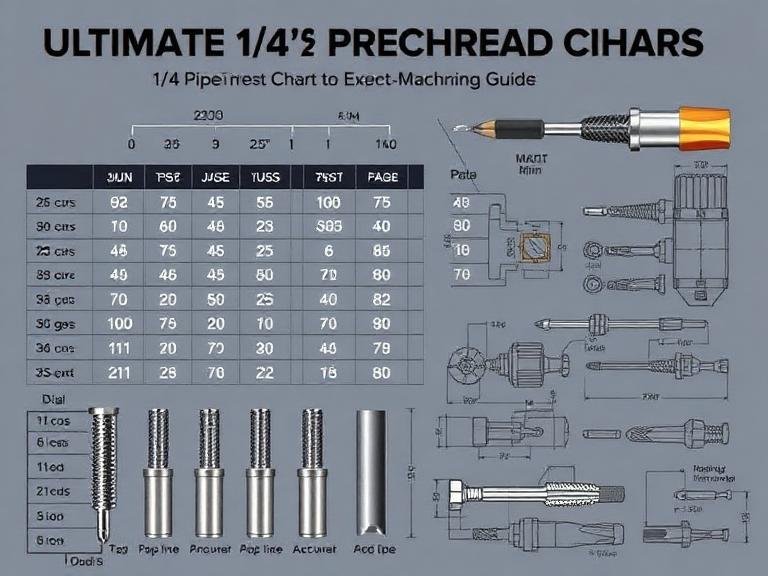
To ensure perfect thread engagement and optimal thread percentage, the pre-drilled hole size must be exact. We recommend referencing the following 1/4 pipe thread tap size chart before beginning any cutting operation. Utilizing the incorrect drill bit will either cause the tap to bind and shatter in the workpiece or result in shallow, stripped threads that cannot hold pressure.
| Thread Standard | Designation | Threads Per Inch (TPI) | Major Diameter (Inches) | Major Diameter (mm) | Recommended Drill Size (Inches) | Recommended Drill Size (mm) |
|---|---|---|---|---|---|---|
| American Taper Pipe | 1/4 – 18 NPT | 18 | 0.540″ | 13.716 mm | 7/16″ | 11.11 mm |
| American Dryseal Taper | 1/4 – 18 NPTF | 18 | 0.540″ | 13.716 mm | 7/16″ | 11.11 mm |
| British Standard Taper | 1/4 – 19 BSPT (Rc) | 19 | 0.518″ | 13.157 mm | 29/64″ | 11.40 mm |
| British Standard Parallel | 1/4 – 19 BSPP (G) | 19 | 0.518″ | 13.157 mm | 15/32″ | 11.80 mm |
When dealing with tapered threads such as the 1/4-18 NPT, we highly recommend utilizing a taper pipe reamer following the drilling operation and before introducing the 1/4 pipe thread tap. A reamer cuts the exact 1 degree 47 minute taper into the hole wall, drastically reducing the cutting load on the tap and ensuring a superior surface finish on the threads.
3. Metallurgy and Coatings for the 1/4 Pipe Thread Tap
The operational lifespan of a 1/4 pipe thread tap is directly dictated by its metallurgical composition and exterior coating. High-Speed Steel (HSS) is the baseline material, suitable for machining aluminum, brass, and mild steels. However, for continuous production environments or when machining hardened stainless alloys, a standard HSS tap will dull rapidly. We recommend upgrading to High-Speed Steel with Cobalt (HSSE), which offers vastly superior heat resistance and edge retention.
Furthermore, surface coatings are essential for high-yield manufacturing. A Titanium Nitride (TiN) coating, recognizable by its gold color, significantly increases surface hardness and reduces friction, allowing the 1/4 pipe thread tap to operate at higher cutting speeds. For extreme applications involving cast iron or high-tensile aerospace alloys, a Titanium Carbonitride (TiCN) coating provides the ultimate protection against abrasive wear. At MisolTap, our advanced R&D division continuously develops proprietary coating matrices to extend tool life across all industrial applications.
4. Expert Machining Best Practices
From our experience consulting with CNC operators globally, the physical act of tapping a pipe thread requires distinct protocols compared to standard straight machine threads. Because a tapered 1/4 pipe thread tap engages more cutting teeth simultaneously the deeper it travels into the bore, the required machine torque increases exponentially.
First, absolute perpendicular alignment is mandatory. Any angular deviation between the spindle and the workpiece will cause the 1/4 pipe thread tap to cut an oversized, oval hole, ruining the interference fit required for sealing. Second, peck tapping is highly discouraged for tapered pipe threads. You must commit to a continuous cutting motion to the required depth, and then immediately reverse the spindle. Stopping the tap midway allows the material to shrink slightly around the tool, frequently resulting in catastrophic tool breakage upon restart.
Finally, copious application of specialized cutting fluid is required. Unlike straight threads where coolant simply flushes chips, a tapered 1/4 pipe thread tap relies on extreme pressure boundary lubrication to prevent the metal from tearing. We recommend using a high-sulfur tapping oil for ferrous metals and a synthetic emulsion for non-ferrous materials to guarantee pristine thread flanks.
5. MisolTap: High-Performance Threading Solutions

Since our founding in 2005, MisolTap has relentlessly pursued perfection in the manufacturing of thread cutting tools. We understand that global manufacturing facilities require absolute consistency. Whether you are operating a manual turret lathe or a multi-axis CNC machining center, our catalog is engineered to deliver precise, repeatable results.
We strictly adhere to international dimensional standards, ensuring that every 1/4 pipe thread tap we produce meets rigorous quality control benchmarks. Our product lineup includes:
- IOS-529 Thread Tap: Engineered for universal compatibility and exceptional performance across a wide range of standard industrial materials. This line provides maximum value and reliability for general machining applications.
- DIN371 Thread Tap: Manufactured to exacting German standards, featuring a reinforced shank design. We recommend the DIN371 specification for heavy-duty applications where maximum torsional rigidity is required to prevent tap breakage during deep hole tapping.
- JIS Thread Tap: Precision crafted to Japanese Industrial Standards, these taps are highly optimized for use in advanced CNC machinery, offering superior chip evacuation geometries and ultra-tight pitch tolerances.
6. Common Troubleshooting When Using a 1/4 Pipe Thread Tap
Even with the best tooling, machinists occasionally encounter flawed threads. Identifying the root cause quickly saves valuable machine time and raw material. If your 1/4 pipe thread tap is producing torn or rough threads, the primary culprit is usually insufficient cutting fluid or a dull cutting edge. Heat buildup causes the material to weld to the tap flutes (built-up edge), which then tears the surrounding metal.
If the final pipe fitting threads in too deeply or bottoms out without sealing, the 1/4 pipe thread tap was driven too far into the bore. Tapered threads rely on depth for sizing. We recommend utilizing a specialized pipe thread ring gauge to determine the exact required depth. Set your CNC depth parameters conservatively, and adjust incrementally until the gauge sits flush with the prescribed standoff.
7. Summary Table: 1/4 Pipe Thread Tap Specifications
To assist your engineering and tooling procurement departments, we have compiled a quick-reference summary matrix of the critical parameters defining the 1/4 pipe thread tap.
| Parameter | NPT Standard Specification | BSP Standard Specification |
|---|---|---|
| Thread Angle | 60 Degrees (Flattened Roots/Crests) | 55 Degrees (Rounded Roots/Crests) |
| Threads Per Inch (TPI) | 18 TPI | 19 TPI |
| Geometry | Tapered (1 degree 47 mins) | Tapered (BSPT) or Parallel (BSPP) |
| Pre-Drill Size | 7/16″ (11.11 mm) | 11.40 mm (BSPT) / 11.80 mm (BSPP) |
| Primary Sealing Mechanism | Interference Fit + Sealant (Teflon/Dope) | Interference Fit (BSPT) / O-Ring or Washer (BSPP) |
8. Frequently Asked Questions (FAQs)
Why does a 1/4 pipe thread tap measure larger than 1/4 inch?
The 1/4 inch designation refers to the historical internal flow diameter (ID) of a schedule 40 steel pipe, not the outside thread dimension. The actual major diameter of a 1/4 pipe thread tap is approximately 0.540 inches. You must always refer to a standardized size chart rather than measuring the tool with calipers to determine drill size.
Can I use a straight drill bit instead of a taper reamer for NPT threads?
While it is common practice in low-volume manual machining to use a standard straight drill bit (7/16″ for 1/4 NPT), we highly recommend using a taper pipe reamer for high-volume or precision CNC work. Drilling a straight hole leaves excessive material at the top of the bore, causing the 1/4 pipe thread tap to work significantly harder, accelerating tool wear and increasing the risk of breakage.
Are NPT and BSPT threads interchangeable?
Absolutely not. From our experience, attempting to thread an NPT fitting into a BSPT port will result in catastrophic failure. The 1/4 NPT operates at 18 TPI with a 60-degree angle, while the 1/4 BSPT operates at 19 TPI with a 55-degree angle. The differing pitch and thread geometry will strip the threads and prevent a pressure-tight seal.
What does the “F” in NPTF stand for?
NPTF stands for National Pipe Taper Fuel (or Dryseal). An NPTF 1/4 pipe thread tap is manufactured to incredibly tight tolerances so that the crests of the threads crush into the roots during assembly. This creates a mechanical seal that theoretically does not require Teflon tape or pipe dope, making it ideal for high-pressure fuel and hydraulic systems.
9. Industry References
For further education on precision machining, thread tolerances, and fluid dynamics, we recommend consulting the following authoritative engineering resources:
- The American Society of Mechanical Engineers (ASME) – Standards for Pipe Threads, General Purpose (Inch)
- International Organization for Standardization (ISO) – ISO 7-1 Pipe threads where pressure-tight joints are made on the threads
- National Institute of Standards and Technology (NIST) – Metrology and Dimensional Tolerance Research