
In modern high-volume manufacturing, precision CNC machining, and industrial component assembly, the selection of thread cutting tools dictates both production throughput and component integrity. Thread tapping is often the final processing step executed on an intricately machined workpiece, meaning a tooling collision, pitch mismatch, or tap breakage can instantly scrap a high-value block of material. When setting up an automated production line, engineers face a permanent foundational decision: deploying metric vs. imperial thread taps. Selecting the correct threading standard goes beyond simple unit conversions; it directly influences your global supply chain, tooling availability, and mechanical load performance.
Since our founding in 2005, MisolTap has established itself as a leading Chinese manufacturer of high-performance thread cutting tools. We integrate research and development, production, and global sales into a seamless operation, providing our clients with robust and precise threading solutions tailored to modern manufacturing needs. From our experience, many manufacturing facilities lose significant profitability by mixing thread standards or using incorrect drilling parameters on advanced alloys. This definitive guide delivers a technical analysis comparing Metric vs. Imperial thread taps, detailing pitch geometry, tolerance definitions, and strategic selection protocols to optimize your shop floor efficiency.
Table of Contents
- 1. Technical Overview: Thread Standards Compared
- 2. Geometric Physics: Flank Angles and Pitch Configurations
- 3. Selecting by Industry: Global Supply Chains and Market Demands
- 4. Machining Execution: Speeds, Tolerances, and Specialized Tapping
- 5. Frequently Asked Questions (FAQs)
- 6. Industrial Safety and Academic References
1. Technical Overview: Thread Standards Compared
Before modifying CNC G-code or procuring large tool batches, production managers must master the core dimensional designations separating metric vs. imperial thread taps. The table below outlines the primary technical variances observed across standard industrial fastners in 2026.
| Technical Parameter | Metric Thread Taps (ISO Standards) | Imperial Thread Taps (Unified National / British) |
|---|---|---|
| Measurement System Base | Millimeters (mm) | Inches (in) |
| Pitch Definition Method | Linear distance from thread crest to crest (e.g., 1.5mm) | Total number of Threads Per Inch (TPI) (e.g., 16 TPI) |
| Standard Designations | M10 x 1.5, M8 x 1.25, M6 x 1.0 | 3/8″-16 UNC, 1/4″-20 UNC, 5/16″-18 UNC |
| Standard Flank Angle | 60-degree symmetrical equilateral triangle | 60 degrees (UNC/UNF) or 55 degrees (BSW/G-threads) |
| Tolerance Class Systems | 6H (Standard internal), 6g (Standard external) | 2B (Standard commercial internal), 3B (Aerospace high-precision) |
| Dominant Global Markets | Worldwide, Europe, Asia, International Automotive | North America, United States, Aerospace, Legacy Machinery |
2. Geometric Physics: Flank Angles and Pitch Configurations
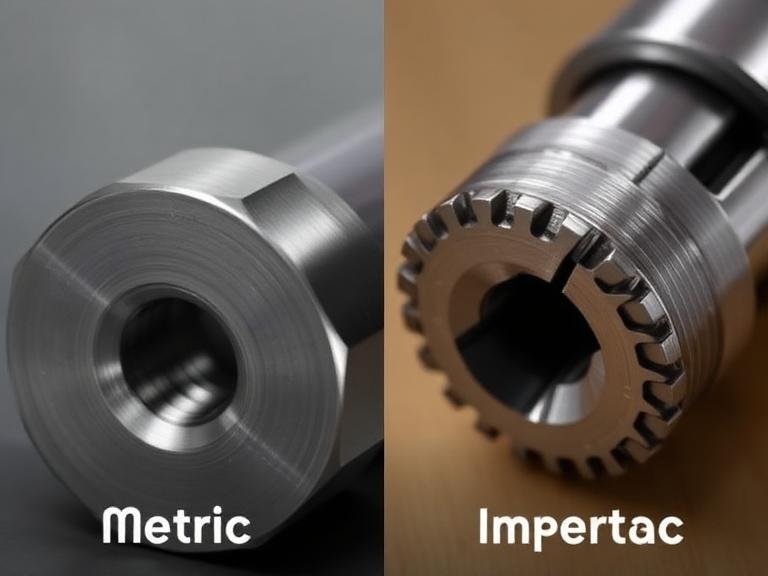
To successfully evaluate metric vs. imperial thread taps, you must look past simple labeling and understand the micro-geometry of the cutting teeth. The International Organization for Standardization (ISO) metric screw thread utilizes a flat crest and a rounded root profile shaped around a 60-degree equilateral triangle. This geometry simplifies stress distribution along the engagement flank, offering robust stripping resistance across structural steel framing and machine castings.
Imperial systems—primarily the Unified Thread Standard (UTS) common in North America—consist of Unified National Coarse (UNC) and Unified National Fine (UNF) series. While UNC/UNF variants share the identical 60-degree flank angle of metric designs, legacy British systems like the British Standard Whitworth (BSW) utilize a distinct 55-degree flank angle with heavily rounded crests and roots. From our experience, running an imperial tap into a pre-drilled metric hole (or vice versa) because the nominal diameters seem visually close—such as an M8x1.25 bolt vs. a 5/16″-18 UNC fastener—will permanently cross-thread and chew up the structural matrix, leading to immediate joint failure under mechanical load.
From Our Experience: The Pitch Definition Pitfall
We recommend ensuring your machining team understands that metric and imperial taps require completely different programming math for feed-rate synchronization during rigid tapping cycles. A metric tap’s pitch is explicitly stated as the true distance between adjacent threads (e.g., a pitch of 1.5mm means the tool must feed exactly 1.5mm per one full spindle revolution). An imperial tap calculates pitch inversely using Threads Per Inch (Pitch = 1 / TPI), meaning a 16 TPI tap requires the machine to feed 1/16th of an inch per revolution. Commingling these units in your CNC controller results in instant tool breakage.
3. Selecting by Industry: Global Supply Chains and Market Demands
The choice between metric vs. imperial thread taps is frequently dictated by target market location and regional contract requirements. Operating as a premier international supplier allows our team to observe how different global value chains organize their tooling packages.
Metric threads are essentially the universal language of modern international automotive, consumer electronics, and renewable energy manufacturing. If your product is destined for assembly hubs across Europe, Asia, or international export markets, metric configurations are mandatory to avoid costly conversion errors and ensure seamless interchangeability. Imperial threads remain deeply entrenched across North American aerospace, domestic petroleum extraction infrastructure, and heavy agricultural machinery. Sourcing through leading global thread tap manufacturers who maintain active inventories of both certified metric and UTS tool families ensures your facility can fulfill diverse contract specifications without suffering shipping delays.
4. Machining Execution: Speeds, Tolerances, and Specialized Tapping

Maximizing tool life during tapping operations depends on precise matching between your pre-tap drill size, your material properties, and your active spindle speeds.
Controlling Cutting Velocities Through Tough Metals
When tapping complex alloys or hardened carbon steels, your initial drilling approach shapes the success of the thread. A common point of debate among machine operators centers on how rotational velocity impacts material hardness. For an in-depth analysis of these performance factors, consult our expert guide on drilling speed for metal, which details how managing thermal dissipation and chip evacuation prevents work hardening before the tap even touches the hole.
To avoid tool binding, your tapping kits must match the structural density of the workpiece. Sourcing your tooling arrays from our verified heavy duty tap and drill catalog guarantees that the cutting edges possess the required carbide grade and advanced coatings (such as TiAlN) to slice uniform threads in demanding materials without chipping.
Specialized Sizing Charts and Rotational Dynamics
For industrial fluid logistics, heavy hydraulic installations, and piping systems, specialized tapered or straight pipe tap sizes are required to form pressure-tight seals. Operators setting up smaller gas or fluid lines can utilize our complete pipe thread tap size chart to check exact decimal hole tolerances. If your blueprint specifies larger fluid routing paths, our engineering analysis of the 3/8 pipe thread tap size provides precise thread-per-inch calculations for secure industrial fits.
Finally, for unique mechanical assemblies like rotating axles or specialized industrial machinery where constant directional torque would loosen standard fasteners, left-handed threading tools become necessary. Exploring the engineering properties and performance benefits in our guide to reverse thread taps highlights how these specialized counter-rotational profiles protect critical sub-assemblies from vibrating loose over time.
5. Frequently Asked Questions (FAQs)
Can I use a metric tap in an imperial hole if the diameters measure close with a caliper?
No. Even if the nominal outer diameters appear close visually (e.g., M8 measuring ~7.9mm vs. a 5/16″ imperial bolt measuring ~7.94mm), their thread pitch and flank profiles are completely non-interchangeable. Attempting to force a mismatch will strip the internal thread wall, cross-thread the bolt, and compromise the clamping force of the joint under mechanical stress.
What does the designation M12 x 1.5 mean on a metric thread tap?
The letter “M” indicates a standard ISO metric screw thread configuration. The number “12” identifies the nominal major diameter of the tool in millimeters, while the second number “1.5” specifies the thread pitch, meaning the precise distance from one thread crest to the next is exactly 1.5 millimeters.
Why do fine-pitch threads offer higher resistance to loosening under vibration?
Fine-pitch threads (such as metric MF or imperial UNF series) feature a smaller pitch angle compared to coarse series. This shallow helix angle acts as a gentler wedge, providing a greater total contact surface area over the same length of thread engagement, which directly improves friction resistance against vibrational loosening.
What is rigid tapping, and why is it preferred for high-volume CNC production?
Rigid tapping, or synchronous tapping, electronically locks the CNC machine’s spindle rotation directly to its linear feed axis. This exact tracking ensures the tap feeds at a precise rate matching its thread pitch per revolution, eliminating the need for floating compression tap holders and drastically reducing tool breakage during high-speed production.
What tolerance class should I select for standard commercial internal tapping?
For standard commercial internal thread processing, a metric 6H tolerance class or an imperial Class 2B designation is the industry standard. These classes provide an optimal fit balance, allowing for easy fastener assembly while maintaining sufficient mechanical strength for general manufacturing and automotive tasks.
6. Regulatory and Industrial References
For official engineering dimensional data, material testing protocols, and international threading safety standards, consult these authoritative organizations:
- International Organization for Standardization. ISO 68-1: General Purpose Screw Threads – Basic Profile Metrics.
- American Society of Mechanical Engineers (ASME). ASME B1.1: Unified Inch Screw Threads (UN and UNR Thread Form) Specifications.
- Deutsches Institut für Normung (DIN). DIN 13-1: General Purpose ISO Metric Screw Threads Coarse Pitch Guidelines.