
Selecting the best thread tap drill bits is one of the most critical decisions a machinist or manufacturer can make. When establishing internal threads in metal, plastic, or composite materials, the quality of your tooling directly dictates the integrity of your fastener joints, the efficiency of your production line, and the overall lifespan of your equipment. From our experience, utilizing substandard tooling almost inevitably leads to poor thread quality, broken taps stuck in valuable workpieces, and costly downtime.
Since our founding in 2005, MisolTap has established itself as a leading Chinese manufacturer of high-performance thread cutting tools. We integrate R&D, production, and global sales into a seamless operation, providing our clients with robust and precise threading solutions tailored to modern manufacturing needs. Throughout our decades of operational expertise, we have continually tested, iterated, and analyzed the metallurgical properties of tapping tools to define what truly constitutes the best thread tap drill bits on the market.
In this comprehensive industry guide, we will analyze the top-performing tapping solutions available today, exploring their geometries, material compositions, and ideal use cases. Whether you are dealing with abrasive cast iron or ductile aluminum, identifying the best thread tap drill bits for your specific application is paramount to operational success.
Table of Contents
Understanding the Best Thread Tap Drill Bits
Before diving into our specific recommendations, it is vital to understand the engineering principles that separate the best thread tap drill bits from mediocre alternatives. The performance of a tap is primarily governed by three factors: the base material, the flute geometry, and the surface coating.
From a material standpoint, High-Speed Steel (HSS) is the industry baseline, offering a great balance of toughness and wear resistance. For tougher applications, Cobalt-alloyed High-Speed Steel (HSSE) provides superior heat resistance, making it ideal for stainless steel. Solid carbide taps represent the pinnacle of rigidity and wear resistance, suited primarily for high-volume CNC environments where extreme speeds are required.
Geometry plays an equally crucial role. Flute design determines how a tap manages the chips it creates. For instance, spiral flute taps pull chips up and out of a blind hole, preventing packing and tap breakage. Conversely, spiral point taps push the chips forward, making them perfect for through holes. When we recommend the best thread tap drill bits, we always emphasize matching the flute geometry strictly to the hole type.
Summary Table of the 9 Best Thread Tap Drill Bits
| Rank | Tool Name | Flute Type | Ideal Application | Material |
|---|---|---|---|---|
| 1 | MisolTap MSL037 Spiral Groove Tap | Spiral Groove | Blind holes, ductile materials | Premium HSS-E |
| 2 | MisolTap MSL002 Straight Flute Thread Tap | Straight Flute | Cast iron, short-chipping metals | HSS |
| 3 | MisolTap MSL001 Straight Flute Thread Tap | Straight Flute | General purpose, through holes | HSS |
| 4 | Titanium Coated Spiral Point Tap | Spiral Point | High-speed through holes | HSS with TiN Coating |
| 5 | Cobalt Heavy-Duty Hand Tap | Straight Flute (Hand) | Stainless steel, maintenance | Cobalt (HSSE) |
| 6 | Carbide Forming Tap (Roll Tap) | Chipless / Form | Aluminum, copper, brass | Solid Carbide |
| 7 | Interrupted Thread Tap | Interrupted Straight | Titanium, tough alloys | Premium HSS |
| 8 | Tapered Pipe Tap (NPT) | Straight Flute (Tapered) | Pipe fittings, fluid seals | HSS |
| 9 | Combination Drill and Tap Bit | Combination | Rapid sheet metal tapping | HSS |
Detailed Reviews of the 9 Best Thread Tap Drill Bits
1. MisolTap MSL037 Spiral Groove Tap
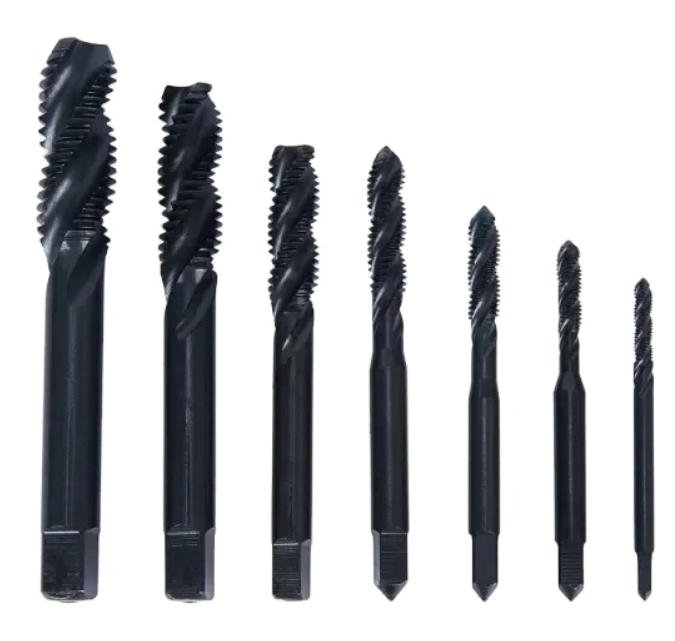
When dealing with blind holes where chip evacuation is critical, the MSL037 Spiral Groove Tap stands out as one of the absolute best thread tap drill bits available. The engineered spiral groove actively lifts swarf upward and out of the hole, preventing chip packing at the bottom which is the leading cause of tool breakage. From our experience, this tap performs exceptionally well in ductile materials like carbon steel, stainless steel, and aluminum. The precise edge geometry reduces cutting forces, ensuring excellent thread finish and dimensional accuracy.
2. MisolTap MSL002 Straight Flute Thread Tap
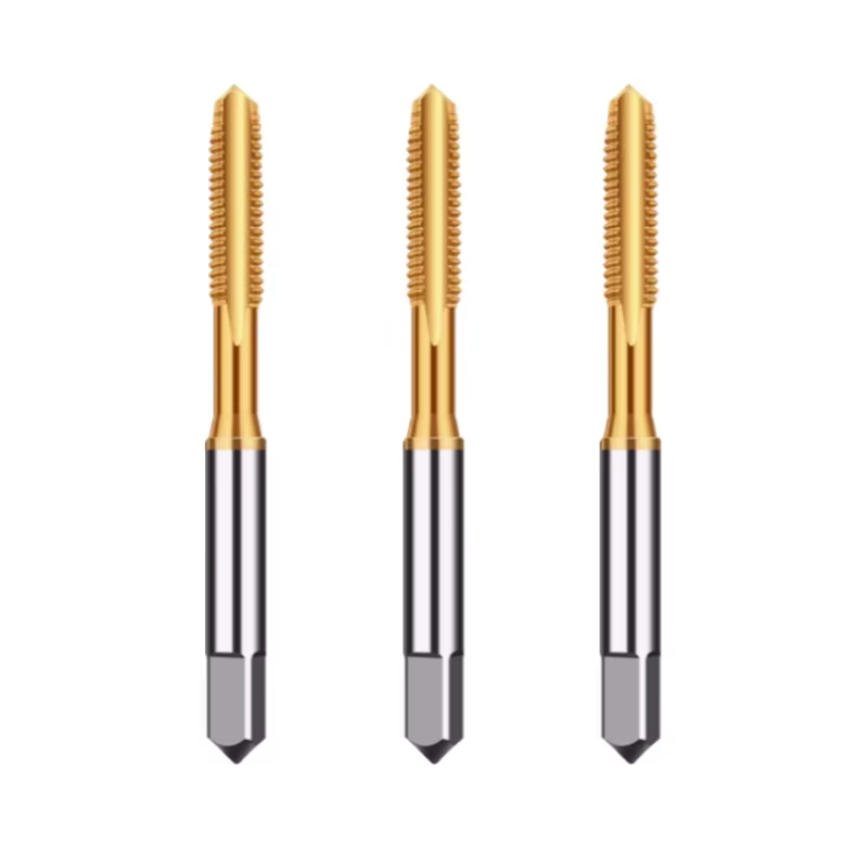
For materials that produce short, brittle chips, such as cast iron or certain brass alloys, the MisolTap MSL002 Straight Flute Thread Tap is an unmatched solution. Straight flute taps are traditionally the most robust design because they have the largest cross-sectional area. We recommend the MSL002 for production environments where rigidity is paramount. Because the chips in cast iron break easily, a spiral lifting action is unnecessary; instead, the straight flutes allow for high-torque cutting and maximum tool longevity, solidifying its place among the best thread tap drill bits for brittle metallurgies.
3. MisolTap MSL001 Straight Flute Thread Tap
The MSL001 Straight Flute Thread Tap is our general-purpose champion. Hand tapping and low-volume machine tapping require tools that offer versatility and durability across a wide range of standard steels and non-ferrous metals. The MSL001 delivers exactly that. Its cutting geometry is optimized to minimize torque spikes during manual or low-speed operations. If your workshop requires a reliable, everyday workhorse for standard maintenance or general fabrication, the MSLO01 ranks highly as one of the best thread tap drill bits for everyday utility.
4. Titanium Coated Spiral Point Tap
Also known as gun taps, spiral point taps are explicitly designed for through holes. The angular grind at the tip pushes the chips forward, ahead of the tap, allowing the flutes to remain shallow and the core to remain thick and strong. When enhanced with a Titanium Nitride (TiN) coating, these tools gain significant lubricity and surface hardness, allowing for higher cutting speeds. For high-volume CNC through-hole applications, these are undeniably some of the best thread tap drill bits on the market.
5. Cobalt Heavy-Duty Hand Tap
When threading challenging, work-hardening materials like 304 or 316 stainless steel, standard HSS often degrades rapidly due to excessive heat. Taps alloyed with 5 percent to 8 percent cobalt (HSSE) maintain their hardness at much higher temperatures. A heavy-duty cobalt tap will cleanly cut threads where standard bits would dull and bind. For aerospace and heavy industrial applications involving tough alloys, cobalt variations represent the best thread tap drill bits for thermal resistance.
6. Carbide Forming Tap (Roll Tap)
Unlike traditional cutting taps, forming taps displace material to create the thread rather than cutting it away. This chipless process cold-works the metal, resulting in threads that are exceptionally strong due to the unbroken grain structure of the material. Forming taps require highly ductile materials like aluminum or low-carbon steel. Solid carbide forming taps offer supreme wear resistance and are the best thread tap drill bits for mass-producing threaded holes in automotive aluminum die castings.
7. Interrupted Thread Tap
Interrupted thread taps feature an alternating tooth design where every other tooth is removed. This specific geometry drastically reduces friction and allows for better flow of cutting fluids directly to the cutting edge. From our experience, when tapping titanium or other gummy metals that tend to gall and seize on the tool, an interrupted thread tap is the optimal solution. By minimizing the contact area, they reduce the torque required to turn the tap, preventing breakage in highly expensive workpieces.
8. Tapered Pipe Tap (NPT)
Creating threads designed to seal fluids or gases requires specialized tooling. National Pipe Taper (NPT) taps are manufactured with a precise taper that allows the male and female threads to wedge together, creating a pressure-tight seal. High-quality NPT taps must feature incredibly strict dimensional tolerances. For plumbing, hydraulic, and pneumatic manufacturing, a premium NPT tap is essential and sits firmly on the list of the best thread tap drill bits for fluid mechanics.
9. Combination Drill and Tap Bit
Efficiency is a massive driver in modern fabrication. Combination drill and tap bits allow operators to drill the root hole, cut the threads, and deburr the edge in a single, continuous operation. While they are not suited for deep holes or extremely hard materials, they are revolutionary for sheet metal work, electrical panel building, and aluminum extrusion framing. For rapid assembly tasks, these dual-purpose tools are highly regarded as the best thread tap drill bits for time-saving efficiency.
How to Choose the Best Thread Tap Drill Bits
Selecting the best thread tap drill bits for your specific project requires a careful analysis of your operating parameters. We recommend evaluating the following criteria before initiating any threading operation:
Firstly, analyze the hole type. Is it a blind hole (does not go completely through the material) or a through hole? For blind holes, you absolutely need a spiral flute tap like the MisolTap MSLO37 to extract the chips upward. If you push chips downward into a blind hole, the tap will bottom out on the compacted chips and shatter. For through holes, spiral point taps or straight flute taps like the MisolTap MSLO01 are ideal.
Secondly, consider the material being machined. Soft, gummy materials like aluminum require highly polished flutes and sharp cutting edges to prevent material from welding to the tap. Abrasive materials like cast iron are best handled by robust straight flute geometries like the MisolTap MSLO02. Tough materials like titanium require specialized tooling such as interrupted thread taps to reduce friction.
Lastly, always ensure you are using the correct pre-drill hole size. Using a drill bit that is too small will cause the tap to cut too high of a thread percentage, resulting in extreme torque forces and inevitable tool failure. Conversely, drilling too large of a hole will result in weak threads that may strip under load. Always consult a standard drill and tap chart to determine the optimal foundational hole size for your best thread tap drill bits.
Frequently Asked Questions (FAQs)
“`
“`
References
1. Society of Manufacturing Engineers (SME). Fundamentals of Tool Design, Thread Cutting and Forming Parameters.
2. Machining Data Handbook. Recommendations for Speeds, Feeds, and Thread Percentages in Ferrous and Non-Ferrous Alloys.