
Machining internal threads in materials exceeding 45 HRC poses a significant engineering challenge for modern manufacturing facilities. Utilizing standard high-speed steel cutting tools on these rigid workpieces often results in rapid edge wear, dimensional inaccuracies, and catastrophic tool breakage. To achieve consistent thread quality and extended tool life, selecting the appropriate Taps for Hardened Steel is a strict operational requirement for any machine shop focused on precision.

Since our founding in 2005, MisolTap has established itself as a leading Chinese manufacturer of high-performance thread cutting tools. We integrate R&D, production, and global sales into a seamless operation, providing our clients with robust and precise threading solutions tailored to modern manufacturing needs. In this technical guide, we will outline the optimal tooling choices and operational strategies for threading high-hardness alloys, ensuring your production lines operate with maximum efficiency and reliability.
Table of Contents
The Mechanics of Threading High-Hardness Alloys
When working with hardened alloys, the mechanical properties of the workpiece—specifically its high tensile strength and abrasive nature—create immense torque and thermal loads during the cutting process. Standard taps cannot withstand temperatures that frequently approach 1000 degrees Celsius at the cutting edge. Therefore, specialized Taps for Hardened Steel are engineered using advanced substrates like solid micro-grain carbide or powdered metallurgy, combined with heat-resistant coatings such as Titanium Carbonitride (TiCN) or Aluminum Titanium Nitride (ALTiN).
From our experience, utilizing the incorrect tap geometry or an inferior substrate in these conditions will inevitably lead to broken tools lodged inside expensive components. The selection of Taps for Hardened Steel must carefully account for chip evacuation dynamics, radial cutting pressure, and the specific hardness of the material being machined. Hardened steel typically produces short, powdery chips, which dictates the core thickness and flute design required to extract material without packing and binding.
Summary Table: Top Taps for Hardened Steel
The following table provides a rapid reference for the top performing Taps for Hardened Steel based on application type and material hardness limits. We recommend using this data as a baseline for initial tool selection before fine-tuning your cutting parameters.
| Tool Type | Ideal Application | Maximum Hardness | Key Mechanical Advantage |
|---|---|---|---|
| MisolTap MSL002 Straight Flute | Through holes, short-chipping steel | 55 HRC | Maximum core rigidity and torsional strength |
| MisolTap MSL037 Spiral Groove | Deep blind holes | 50 HRC | Superior upward chip evacuation |
| Solid Carbide TiCN-Coated | High-volume CNC production | 60 HRC | Extreme heat and abrasive wear resistance |
| HSSE-PM (Powder Metallurgy) | Older machines with slight vibration | 52 HRC | High toughness to prevent sudden shattering |
| Heavy-Duty Thread Forming | Highly precise, chip-less threading | 48 HRC | Eliminates chip packing entirely |
| Coolant-Through Carbide | Deep hole threading in tool steel | 60 HRC | Instant thermal quenching and chip flushing |
Top 6 Recommended Taps for Hardened Steel
1. MisolTap MSL002 Straight Flute Thread Tap
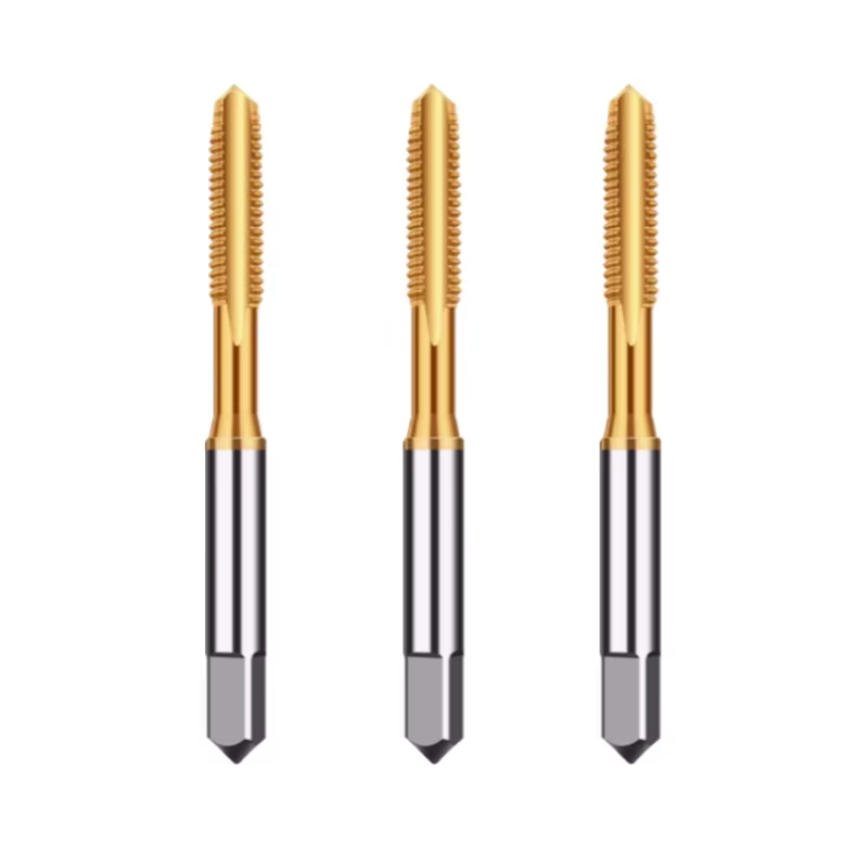
Among the most effective Taps for Hardened Steel is the MisolTap MSL002 Straight Flute Thread Tap. Straight flute designs represent the most rigid tap geometry available on the market. Because they lack deep spiral flutes, the core cross-section of the tap is significantly thicker and stronger. This makes the MSL002 highly resistant to the immense torsional shear forces generated when cutting ISO H materials (hardened steels). The chips produced in hardened steel are typically short and brittle. A straight flute tap excels here, especially in through-hole applications where the chips can be effortlessly pushed forward ahead of the cutting action, keeping the flutes clear.
2. MisolTap MSL037 Spiral Groove Tap
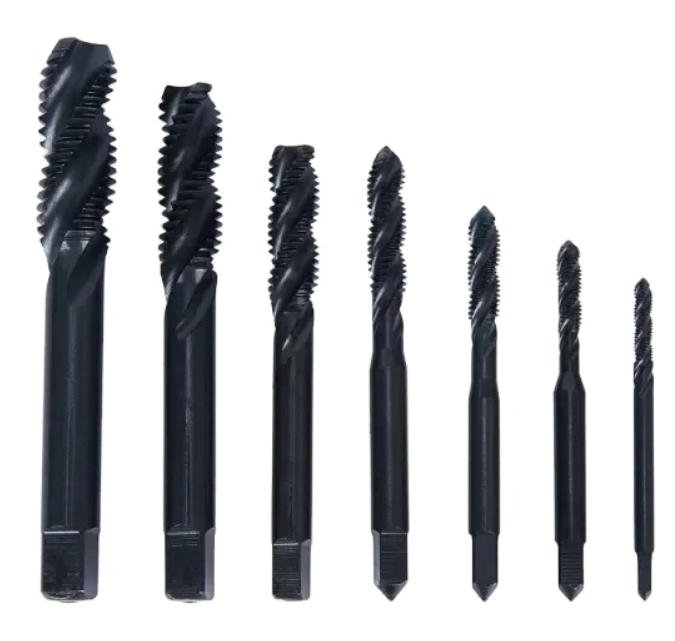
Blind holes present a unique challenge in hard turning because chips cannot be pushed through the bottom of the bore. For these demanding applications, we recommend the MisolTap MSL037 Spiral Groove Tap. This tool features a precision-engineered spiral groove designed specifically to lift short, abrasive chips up and out of the hole against the direction of the cut. This upward evacuation prevents chip packing at the bottom of the hole, which is the leading cause of tool failure when tapping blind holes. As a premier choice for Taps for Hardened Steel, the MSL037 is essential for aerospace, medical, and automotive components requiring flawless internal threads.
3. Solid Carbide TiCN-Coated Taps
When evaluating Taps for Hardened Steel for extreme hardness levels (up to 60 HRC), solid carbide is the uncompromising industry standard. Solid carbide offers unparalleled rigidity and heat resistance, often outperforming traditional high-speed steel by up to three times in overall tool life. We recommend pairing the carbide substrate with a Titanium Carbonitride (TiCN) coating. This advanced coating drastically increases the surface hardness of the cutting edge and lowers the coefficient of friction, preventing the abrasive wear that typically destroys inferior tools within seconds of entering the cut.
4. HSSE-PM (Powdered Metallurgy) Taps
While solid carbide is exceptionally hard, it is also inherently brittle. If your machine tool lacks absolute rigidity or suffers from minor spindle runout, solid carbide tools run the risk of shattering. In these real-world scenarios, HSSE-PM (Powdered Metallurgy) Taps for Hardened Steel are the optimal alternative. The powder metallurgy process creates a uniform micro-structure that bridges the gap between the toughness of HSS and the hardness of carbide. These taps absorb micro-vibrations without chipping, making them incredibly reliable for materials in the 45 to 52 HRC range.
5. Heavy-Duty Thread Forming (Roll) Taps
Unlike traditional cutting tools, forming taps displace material via plastic deformation to create the thread profile, meaning absolute zero chips are produced. While typically reserved for softer, ductile materials like aluminum or mild steel, specialized forming Taps for Hardened Steel have been developed for alloys up to 48 HRC. Because they lack flutes entirely, forming taps have a massive core diameter, making them nearly impossible to break under normal conditions. However, we recommend extreme caution regarding pre-hole diameter, as forming taps require ultra-precise hole preparation and high-pressure boundary lubrication.
6. Coolant-Through Carbide Taps
Heat is the primary enemy of any cutting edge, particularly in high-tensile environments. Coolant-Through Carbide Taps for Hardened Steel feature internal coolant channels that deliver high-pressure cutting fluid directly to the cutting zone. This strategic fluid delivery serves two critical purposes: it instantly quenches the cutting edge to prevent thermal cracking, and it forcefully evacuates chips out of the flutes before they can recut. From our experience, utilizing coolant-through technology is highly advantageous when tapping deep blind holes in hardened tool steels, ensuring maximum process reliability and flawless surface finish.
Machining Best Practices and Parameter Control
From our experience, the success of Taps for Hardened Steel relies heavily on the surrounding machining environment. Even the highest quality threading tool will fail prematurely if the cutting parameters and setups are incorrect.
First, we recommend drilling the pre-tap hole to the maximum allowable minor diameter tolerance. By slightly increasing the pre-drill hole size within the acceptable thread class limits (often aiming for a 60% to 65% thread engagement rather than 75%), you drastically reduce the volume of material the tap must remove. This significantly lowers the torque load and extends tool life. Use a high-quality solid carbide drill to ensure the hole is perfectly cylindrical and completely free of work-hardened glazing on the inner wall.
Second, lubrication is absolutely critical. Standard water-soluble coolant often lacks the necessary lubricity for threading hard alloys. We recommend using a heavy-duty tapping paste, molybdenum-disulfide (Moly-D) cutting oil, or sulfur-based tapping fluids to provide a high-pressure boundary layer between the tool and the workpiece. Finally, ensure your machine setup utilizes an axial floating tap holder or a tension-compression collet. Hardened materials are unforgiving; any discrepancy between the machine’s feed rate and the tap’s pitch will cause immense pressure spikes. A floating holder compensates for these micro-errors, protecting your Taps for Hardened Steel from premature snapping.
Frequently Asked Questions (FAQs)
What is the maximum hardness suitable for Taps for Hardened Steel?
Generally, specialized solid carbide Taps for Hardened Steel can process materials up to 60 HRC, and occasionally up to 63 HRC under highly controlled conditions. However, for materials exceeding 55 HRC, we often recommend thread milling as a safer alternative to tapping, as thread milling exerts far less radial pressure on the tool and avoids the risk of getting a broken tap stuck in the part.
Why do my Taps for Hardened Steel keep breaking during operation?
Tap breakage in hardened materials is typically caused by four primary factors: an undersized pre-drilled hole, misalignment between the spindle and the workpiece, insufficient heavy-duty lubrication, or attempting to use a standard HSS tap instead of dedicated Taps for Hardened Steel. Ensuring strict adherence to low cutting speed limits (often between 3 to 10 sfm) is also critical to prevent heat-induced failure.
What is the difference between the MisolTap MSL002 and MSL037?
The MSL002 is a Straight Flute Thread Tap designed specifically for through holes, offering maximum core strength to push chips forward ahead of the cut. The MSL037 is a Spiral Groove Tap engineered for blind holes, utilizing its geometry to pull chips upward and out of the cavity, thereby preventing chip packing and subsequent tool breakage.
Industry References
- Machinery’s Handbook, 31st Edition – Comprehensive guidelines on thread cutting feeds, speeds, and minor diameter tolerances.
- ISO Standard 529 – Specifications for machine taps, thread tolerances, and tooling geometries in metalworking.