
The Comprehensive Guide to the Different Styles of Thread Taps
Since our founding in 2005, MisolTap has established itself as a leading Chinese manufacturer of high-performance thread cutting tools. We integrate R&D, production, and global sales into a seamless operation, providing our clients with robust and precise threading solutions tailored to modern manufacturing needs. In the complex world of machining and metalworking, selecting the correct tooling is the foundation of structural integrity and production efficiency. One of the most critical decisions an engineer or machinist must make involves navigating the different styles of thread taps available in the industrial market today.
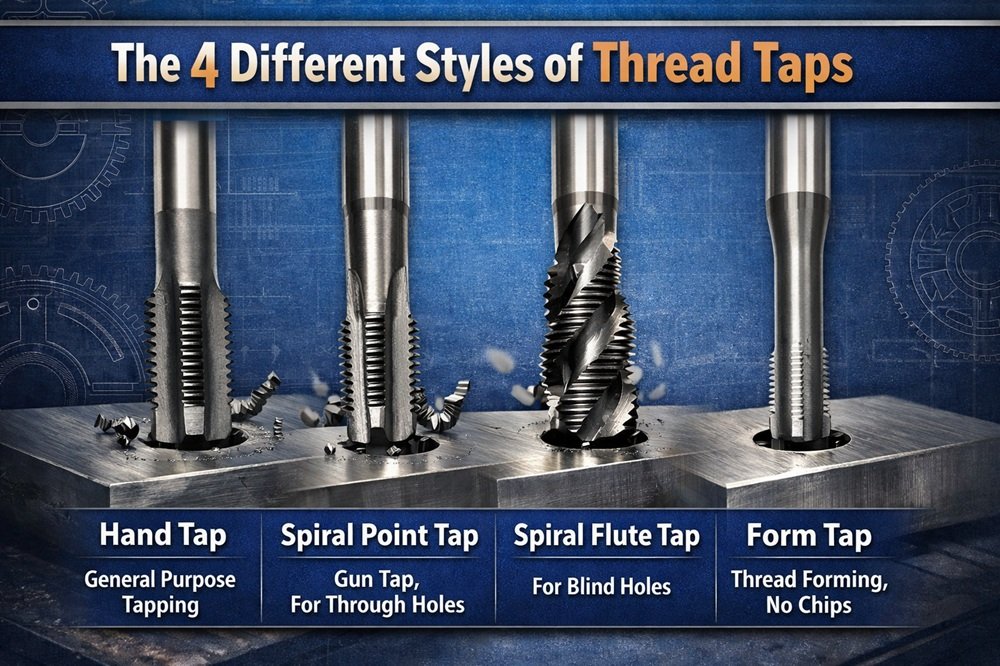
From our experience, utilizing the incorrect tap geometry for a specific material or hole type inevitably leads to catastrophic tool failure, damaged workpieces, and unacceptable production downtime. The different styles of thread taps are engineered with highly specific flute geometries, cutting chamfers, and core diameters to manipulate chip evacuation and cutting forces. Whether you are operating advanced CNC machining centers or performing manual maintenance tapping, understanding the nuanced mechanics of the different styles of thread taps is absolutely essential. We recommend reading this authoritative guide thoroughly to master the selection process and optimize your threading operations for maximum precision and tool longevity.
Table of Contents
- Summary Table: Comparing the Different Styles of Thread Taps
- Understanding the Different Styles of Thread Taps
- Straight Flute Hand Taps
- Spiral Point Taps
- Spiral Flute Taps
- Form Taps (Thread Roll Taps)
- International Tooling Standards: IOS, DIN, and JIS
- How to Choose Among the Different Styles of Thread Taps
- Professional Best Practices for Maximizing Tap Life
- Frequently Asked Questions
- Industry References
Summary Table: Comparing the Different Styles of Thread Taps
To provide immediate clarity, we have compiled an expert summary detailing the primary characteristics and optimal applications for the different styles of thread taps. This quick reference guide highlights the fundamental mechanical differences that dictate tooling selection on the shop floor.
| Tap Style | Flute Geometry | Chip Evacuation Direction | Primary Hole Type Application | Machining Environment |
|---|---|---|---|---|
| Straight Flute Tap | Linear, straight channels | Chips accumulate within the flutes | Through holes and blind holes (with manual clearing) | Manual tapping, cast iron machining, short-chipping materials |
| Spiral Point Tap | Straight flutes with angular cut at the point | Pushes chips forward ahead of the tool | Through holes exclusively | High-speed CNC production, long-chipping materials |
| Spiral Flute Tap | Helical channels (similar to a drill bit) | Pulls chips backward out of the hole | Blind holes exclusively | Automated CNC machining, deep hole tapping |
| Form Tap (Roll Tap) | Fluteless (polygonal geometry) | No chips generated (displaces material) | Both blind and through holes | Ductile materials (aluminum, copper, soft steels) |
Understanding the Different Styles of Thread Taps
To fully grasp the capabilities of the different styles of thread taps, we must examine the physics of internal thread creation. Tapping is an exceptionally demanding machining operation because the cutting edges are constantly engaged with the workpiece, generating immense friction and heat. The design of the tap dictates how the sheared metal (the chip) is managed. If chips are not efficiently evacuated, they will pack into the flutes, bind the tool, and cause it to snap inside the hole. Let us dissect the primary categories of the different styles of thread taps.
Straight Flute Hand Taps
Straight flute taps are the most traditional and recognizable among the different styles of thread taps. As the name suggests, the flutes run parallel to the axis of the tool. From our experience, these taps are highly versatile but possess specific limitations regarding chip evacuation. Because the flutes are straight, they do not actively push or pull the chips; instead, the chips accumulate inside the flute channels. Therefore, straight flute taps are primarily recommended for materials that produce short, brittle chips, such as cast iron or certain brass alloys. They are also widely used in manual tapping operations where the operator can reverse the tap to break the chip. MisolTap manufactures premium straight flute taps designed for rigid setups where maximum structural strength of the tap core is required.
Spiral Point Taps (Gun Taps)
When evaluating the different styles of thread taps for high-volume production of through holes, the spiral point tap is the absolute standard. Sometimes referred to as a gun tap, this tool features straight flutes for the majority of its body, but the critical innovation lies at the cutting point. The point is ground with an angular bias relative to the tap axis. This unique geometry shears the metal and forcefully projects the continuous chips forward and out ahead of the tap. Because the chips are driven downward, the flutes themselves can be made shallower, which dramatically increases the cross-sectional core strength of the tool. We recommend spiral point taps for high-speed CNC tapping in carbon steels, alloy steels, and stainless steels, provided the hole passes completely through the workpiece so the chips have an exit path.
Spiral Flute Taps
Among the different styles of thread taps, the spiral flute tap is the definitive solution for blind hole applications. A blind hole is drilled to a specific depth and does not break through the bottom of the workpiece. If you were to use a spiral point tap in a blind hole, the chips would be packed into the bottom, causing the tap to crash and break. The spiral flute tap is engineered with helical flutes that wrap around the tool body, functioning identically to an auger or a standard twist drill. This helical geometry actively lifts the chips upward and backward out of the hole, away from the cutting action. From our experience, selecting the correct helix angle (typically ranging from 15 degrees for tough materials to 45 degrees for softer, long-chipping materials like aluminum) is paramount for success. MisolTap produces highly engineered spiral flute taps that guarantee superior thread finish and reliable chip evacuation in deep blind holes.
Form Taps (Thread Roll Taps)
Form taps represent a radical departure from the other different styles of thread taps because they do not cut material at all. Instead of having sharp cutting edges and flutes, form taps possess a polygonal cross-section without traditional flutes. They create threads by cold-forming or displacing the material under extreme pressure. Because no material is removed, no chips are generated. This completely eliminates the problem of chip evacuation, making form taps ideal for both blind and through holes. Furthermore, the cold-forming process work-hardens the thread flanks, resulting in internal threads that are significantly stronger than cut threads. We recommend form taps exclusively for highly ductile materials such as aluminum, copper, brass, and low-carbon steels. They cannot be used on brittle materials like cast iron or hardened tool steels, as the material will fracture rather than flow.
International Tooling Standards: IOS, DIN, and JIS
Mastering the different styles of thread taps also requires an understanding of the dimensional standards that govern their manufacturing. Different regions and industries adhere to specific specifications for overall length, shank diameter, and driving square dimensions. MisolTap operates on a global scale, and our R&D and production facilities are calibrated to meet and exceed all major international standards, ensuring our tooling integrates flawlessly into your existing holders and collets.
IOS-529 Thread Tap
The IOS-529 standard is widely recognized in international manufacturing, dictating the overall dimensions and tolerances for short machine taps and hand taps. The IOS-529 Thread Tap features a robust shank geometry designed to withstand significant torsional forces during heavy-duty cutting. At MisolTap, we manufacture a comprehensive line of IOS-529 Thread Taps, utilizing premium high-speed steel (HSS-E) enriched with cobalt to maintain cutting edge hardness at elevated temperatures. We recommend these taps for general-purpose machining facilities that require highly reliable, standardized tooling across diverse milling and turning centers.
DIN371 Thread Tap
The German DIN standard is globally revered for its rigid engineering specifications. The DIN371 Thread Tap is specifically characterized by its reinforced shank. On a DIN371 tap, the shank diameter is equal to the major diameter of the thread, which provides extraordinary rigidity and resistance to deflection. This standard is typically applied to taps up to size M10. From our experience, the DIN371 Thread Tap is the superior choice when utilizing high-speed CNC synchronization (rigid tapping). The reinforced shank virtually eliminates vibration, resulting in exceptional thread concentricity and surface finish. MisolTap’s DIN371 series represents the pinnacle of our precision engineering capabilities.
JIS Thread Tap
The Japanese Industrial Standard (JIS) dictates the tooling dimensions predominantly used throughout Asian manufacturing ecosystems and by global companies utilizing Japanese CNC machinery (such as Mazak, Makino, or Okuma). The JIS Thread Tap often features unique shank dimensions and square drive proportions compared to European or American standards. As a leading Chinese manufacturer, MisolTap seamlessly integrates into the Asian supply chain, providing high-performance JIS Thread Taps that deliver flawless compatibility and uncompromising tool life. Understanding your machine’s collet requirements is essential to choosing between DIN, IOS, and JIS standards.
How to Choose Among the Different Styles of Thread Taps
With an understanding of the mechanics and standards behind the different styles of thread taps, production engineers must execute a systematic selection process. From our experience, the decision matrix must evaluate three critical variables: hole geometry, workpiece material, and the machine tool environment.
First, identify the hole geometry. If it is a blind hole, your options immediately narrow; you must utilize a spiral flute tap to extract the chips, or a form tap if the material permits. If it is a through hole, a spiral point tap is almost always the most efficient choice due to its superior core strength and forward chip evacuation. Second, evaluate the material’s ductility and hardness. Soft, gummy materials like aluminum heavily favor form taps or high-helix spiral flute taps. Tough, abrasive materials like titanium or Inconel require straight flute or low-helix spiral taps manufactured from powdered metallurgy high-speed steel (PM-HSS) with advanced physical vapor deposition (PVD) coatings. We recommend consulting with MisolTap’s technical engineering team to map the different styles of thread taps directly to your specific alloy.
Professional Best Practices for Maximizing Tap Life
Even when you perfectly select the optimal tool among the different styles of thread taps, improper application will destroy it. Tapping requires meticulous attention to operational parameters. From our experience, the most common cause of tap failure is improper core hole sizing. If the pre-drilled hole is too small, the tap is forced to cut too much material, exceeding its torsional yield strength and snapping. We recommend strictly adhering to standardized drill-tap charts and utilizing high-precision carbide drills to ensure the core hole is perfectly cylindrical and accurately sized.
Furthermore, lubrication is non-negotiable. The friction generated at the cutting interface of any of the different styles of thread taps is immense. Whether you are using neat cutting oil, soluble synthetic coolants, or advanced Minimum Quantity Lubrication (MQL) systems, the cutting fluid must possess high lubricity and extreme pressure (EP) additives. Finally, ensure absolute concentricity between the machine spindle, the tool holder, and the workpiece. Any angular misalignment will exert devastating lateral forces on the tap, leading to oversized threads and catastrophic tool breakage. Rigid tapping cycles on modern CNC machines, paired with high-quality synchronous tapping chucks, provide the optimal environment for MisolTap threading solutions.
Frequently Asked Questions
The fundamental difference lies in chip evacuation direction, which dictates their application among the different styles of thread taps. A spiral point tap pushes chips forward and out the bottom of a through hole. A spiral flute tap pulls chips backward and out the top, making it mandatory for blind holes where chips cannot exit the bottom.
From our experience, the DIN371 Thread Tap is preferred for sizes up to M10 because it features a reinforced shank (the shank diameter matches the thread diameter). This provides maximum rigidity, significantly reducing vibration and tool deflection during high-speed rigid CNC tapping operations.
No. Form taps operate by displacing metal rather than cutting it. Therefore, they can only be used on ductile materials that have the ability to flow under pressure, such as aluminum, copper, brass, and low-carbon steel. Attempting to use a form tap on brittle materials like cast iron will cause the workpiece to fracture.
Since 2005, MisolTap has integrated comprehensive R&D, advanced grinding technology, and strict metallurgical quality control into our production process. We utilize premium high-speed steels and advanced PVD coatings, ensuring that every IOS-529, DIN371, and JIS Thread Tap meets rigorous international performance standards.
Industry References and Technical Standards
- International Organization for Standardization (ISO): ISO 529 – Short machine taps and hand taps.
- Deutsches Institut für Normung (DIN): DIN 371 – Machine taps with reinforced shank for coarse metric threads.
- Japanese Industrial Standards (JIS): JIS B 4430 – Metric coarse thread taps specifications.