
In the high-stakes world of mechanical engineering and industrial machining, selecting the correct thread profile is not a matter of aesthetic preference; it is a critical structural decision. Every day, we see catastrophic mechanical failures on assembly lines and in field operations simply because an engineer or machinist guessed wrong when choosing between a coarse and a fine thread. Misunderstanding the fundamental differences between Unified National Coarse (UNC) and Unified National Fine (UNF) threads leads to stripped aluminum housings, snapped high-tensile bolts, and assemblies that vibrate apart under operational stress.
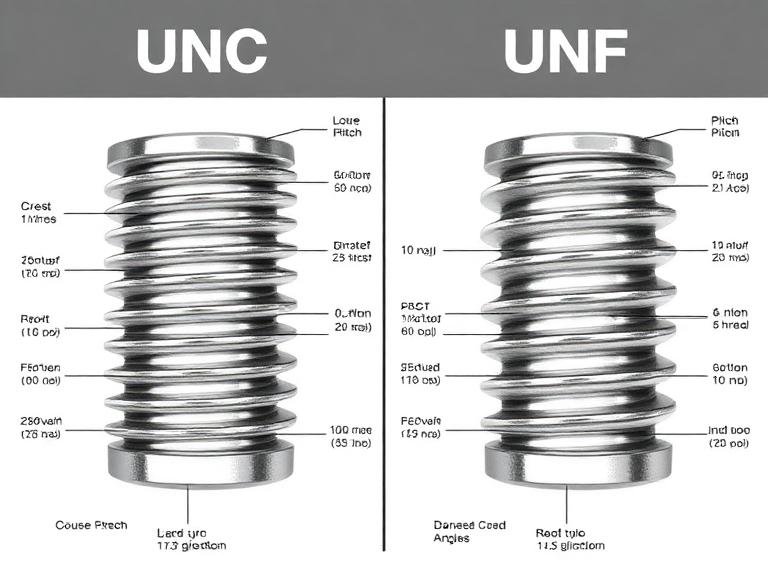
From our experience manufacturing precision cutting tools, the industry is plagued by a misconception that “fine threads are always better” simply because they sound more advanced. This is completely false. Both thread standards exist to solve very specific mechanical problems. If you want to optimize your production line, extend the lifespan of your cutting tools, and guarantee the safety of your fastened joints, you must understand the exact mechanical behaviors of these profiles. In this comprehensive guide, we dissect the core Differences Between UNC and UNF Threads, providing you with the commercial and practical judgment necessary to make the right tooling and design choices.
Quick Answer: UNC vs. UNF
The primary Differences Between UNC and UNF Threads lie in their pitch, strength characteristics, and intended applications. UNC (Coarse) threads have fewer threads per inch, deeper thread engagements, and are vastly superior for threading into soft materials (like aluminum or cast iron) and applications requiring rapid assembly. UNF (Fine) threads have more threads per inch, a larger minor diameter (giving the bolt higher tensile strength), and a shallower helix angle, making them highly resistant to loosening from vibration. Use UNC for general manufacturing and soft metals; use UNF for high-vibration aerospace, automotive, and thin-walled applications.
Table of Contents
- What Are UNC and UNF Threads?
- How They Work: The 7 Important Differences
- Benefits and Limitations
- Who Should Use It & Who Does Not Need It
- Common Machining Mistakes
- Buying Considerations for Taps
- Expert Recommendation from MisolTap
- Frequently Asked Questions (FAQ)
What Are UNC and UNF Threads?
UNC and UNF belong to the Unified Thread Standard (UTS), which dictates the standard thread forms and series for the United States and Canada. The standard features a 60-degree symmetrical V-thread profile.
UNC (Unified National Coarse): This is the default thread for the vast majority of general-purpose fasteners. It is characterized by a larger pitch, meaning there is a greater distance between each thread crest. If a blueprint simply calls for a “1/4-20” bolt, it is specifying a UNC thread.
UNF (Unified National Fine): This series has a smaller pitch, packing more threads into every inch of the fastener. A “1/4-28” bolt indicates a UNF thread. Because the threads are closer together, the actual depth of the thread groove is shallower.
How They Work: The 7 Important Differences Between UNC and UNF Threads
1. Thread Pitch and Physical Depth
The most visible difference is the pitch (Threads Per Inch or TPI). Because UNC has fewer threads per inch, the cutting tool must carve deeper into the metal to form the 60-degree profile. UNF threads are shallower. This fundamental geometric difference dictates every other mechanical property on this list. When you learn how to use a thread tap, you immediately feel that cutting a UNC thread requires moving more raw material out of the hole than a UNF thread.
2. Tensile Strength vs. Shear Strength
There is a massive engineering trade-off here. Because UNF threads are shallower, the solid core of the bolt (the minor diameter) remains thicker. A thicker core means the UNF bolt has higher tensile strength; it can withstand more pulling force before snapping. Conversely, because UNC threads cut deeper into the mating material, they possess higher shear strength in the internal thread. They grip more of the base material, preventing the internal threads from stripping out.
3. Vibration Resistance and Self-Locking
In most professional situations involving engines or heavy machinery, vibration is the enemy. UNF threads have a smaller helix angle (the incline of the thread). This smaller angle creates higher friction between the mating threads, acting as a mechanical self-locking mechanism. UNF fasteners are vastly superior at resisting loosening under heavy vibration, which is why they dominate the automotive and aerospace industries.
4. Assembly Speed and Cross-Threading Risks
For commercial users running high-speed assembly lines, time is money. UNC threads assemble significantly faster because fewer rotations are required to drive the bolt home. Furthermore, the thick, deep profile of coarse threads makes them highly resistant to cross-threading, even when operators are rushing. UNF threads require careful, slow alignment to prevent destroying the starting threads.
5. Performance in Soft Materials
If you are tapping aluminum, cast iron, brass, or plastics, UNC is mandatory. The shallow engagement of a UNF thread in a soft material will shear off immediately under torque. The deep, aggressive bite of a UNC thread distributes the load deeper into the soft substrate. This is a critical factor when choosing the best material for thread taps for your specific workpiece.
6. Machining Tolerances and Tap Breakage
Cutting UNF threads requires impeccable precision. Because the thread profile is so fine, even microscopic chip buildup or a slightly undersized pre-drilled hole will cause the tap to bind and snap. UNC threads, with their wide gullets, evacuate metal chips much easier. For heavy-duty applications, especially when deep-hole tapping, a heavy duty tap and drill setup is far easier to manage with UNC profiles.
7. Fine Adjustment Capabilities
When you need precision linear movement—such as in leveling feet, micrometer adjustments, or valve stems—UNF is the standard. The high TPI means that one full rotation of the screw translates to a much smaller linear advancement compared to UNC, allowing for hyper-accurate calibration.
| Characteristic | UNC (Coarse) | UNF (Fine) |
|---|---|---|
| Tensile Strength (Bolt) | Lower (Smaller minor diameter) | Higher (Larger minor diameter) |
| Internal Shear Strength | Higher (Deeper thread engagement) | Lower (Shallower thread engagement) |
| Vibration Resistance | Poor | Excellent (Self-locking properties) |
| Assembly Speed | Fast | Slow |
| Best Material Compatibility | Soft materials (Aluminum, Cast Iron) | Hard materials (Steel alloys), Thin walls |
Benefits and Limitations
The benefit of UNC threads is absolute reliability in hostile environments. They tolerate dirt, rust, and heavy plating (like hot-dip galvanizing) without seizing. They are the backbone of the construction and heavy equipment industries. Their limitation is that they simply cannot hold torque under high-frequency vibration without the aid of chemical threadlockers or lock washers.
The benefit of UNF threads is their structural supremacy in high-tension, high-vibration environments. Their limitation is extreme fragility during assembly and severe susceptibility to galling (cold welding) if tapped into stainless steel without proper lubrication.
| Thread Standard | Pros | Cons |
|---|---|---|
| UNC (Coarse) | Highly resistant to cross-threading; handles debris well; excellent for soft metals. | Lower tensile strength; loosens easily under vibration. |
| UNF (Fine) | Superior vibration resistance; higher tensile bolt strength; ideal for thin-walled tubes. | Easily cross-threaded; strips easily in soft materials; requires tight machining tolerances. |
Who Should Use It & Who Does Not Need It
For commercial users and general manufacturing: We recommend UNC threads for 80% of standard mechanical assemblies. If you are building structural frameworks, consumer goods, or agricultural equipment, UNC provides the fastest, most reliable assembly process with the lowest risk of thread damage.
For heavy-duty applications and precision engineers: If you are designing aircraft components, high-performance engine internals, or precision fluid valves, you must use UNF threads. The vibration parameters of these environments will destroy coarse threads. Furthermore, if you are working with specialized pneumatic systems, you will often need to bridge the gap into specialized non-standard tooling, such as the 3/8 pipe thread tap size for fluid sealing.
Common Machining Mistakes
The most catastrophic mistake we see on the shop floor is engineers specifying UNF threads for aluminum engine blocks to make it look “high performance.” The moment a mechanic applies proper torque, the internal aluminum threads shear off completely. You must use UNC for aluminum.
Another major operational error involves tapping mechanics. Operators frequently use the wrong tap geometry for the job. If you are cutting a fine thread into a blind hole, understanding the plug tap vs thread tap distinction is vital. Attempting to force a standard plug tap to the bottom of a tight UNF blind hole will result in instant tool breakage. Furthermore, when repairing damaged threads in the field, technicians often grab the wrong pitch gauge, resulting in destroyed housings. Utilizing proper rethreading taps and dies to chase and clean threads requires absolute verification of the TPI before you begin.
Buying Considerations for Thread Taps
When procuring tools from thread tap manufacturers, your buying decision must be guided by your production volume and workpiece material. Do not buy generic high-speed steel (HSS) taps for high-volume UNF production in stainless steel; you need cobalt-alloyed (HSS-E) or powdered metal taps with TiCN coatings to survive the friction.
Additionally, specialized applications require specialized thread directions. If you are building rotating machinery like grinding arbors or bicycle pedals, standard right-hand threads will self-loosen during operation. You must procure reverse thread taps or a dedicated left hand thread tap set to ensure rotational forces keep the joint tightened.
| Workpiece Material | Recommended Thread Type | Recommended Tap Material/Coating |
|---|---|---|
| Aluminum / Soft Alloys | UNC | HSS with Bright Finish (prevents galling) |
| Carbon Steel | UNC or UNF | HSS-E with TiN Coating |
| Stainless Steel / Hardened Alloys | UNF (for strength) | Powdered Metal (PM) with TiCN or TiAlN Coating |
| Cast Iron | UNC | HSS with Steam Oxide Finish |
Expert Recommendation from MisolTap
In most professional situations, the tooling you select dictates your profitability. A broken tap inside an expensive aerospace component ruins margins instantly. While understanding the Differences Between UNC and UNF Threads is the first step, executing those threads flawlessly requires industrial-grade precision.

Precision Threading Solutions by MisolTap
Since our founding in 2005, MisolTap has established itself as a leading Chinese manufacturer of high-performance thread cutting tools. We integrate R&D, production, and global sales into a seamless operation, providing our clients with robust and precise threading solutions tailored to modern manufacturing needs.
Whether you are outfitting a high-speed CNC turning center with ultra-precise UNF spiral point taps, or equipping your maintenance crew with robust UNC hand taps, our meticulously heat-treated and coated cutting tools ensure maximum chip evacuation, superior thread finish, and extended tool life. We recommend auditing your current tooling inventory and upgrading to geometry-specific taps designed for your exact workpiece material to eliminate scrap and machine downtime.
Frequently Asked Questions (FAQ)
Can I tap a UNF thread into aluminum?
While physically possible, we strictly advise against tapping UNF threads into soft materials like aluminum or cast iron. Fine threads have a shallower thread depth, meaning there is less material engagement to resist shear forces. In soft metals, UNF threads will strip out rapidly under load. Always use UNC threads for aluminum.
Why is UNF considered stronger than UNC?
UNF bolts possess a larger minor diameter compared to UNC bolts of the same nominal size. This larger solid core means the bolt has a greater cross-sectional area, giving it higher tensile strength and better resistance to snapping under tension. However, the internal threads of a UNF tapped hole are weaker in shear than UNC.
What happens if I use a UNC tap in a hole drilled for a UNF tap?
The tap will likely break, or the threads will be completely destroyed. UNC and UNF threads require distinctly different pre-drill hole sizes. A UNF hole is too small for a UNC tap, causing immense cutting friction that will snap the tool. Always consult a precise tap drill chart before machining.
Authoritative Industry References
To ensure your mechanical designs meet global compliance, we recommend referencing the following engineering standards:
- The American Society of Mechanical Engineers (ASME B1.1) – The definitive standard defining the specifications, tolerances, and designations for Unified Inch Screw Threads (UN and UNR Thread Form).
- National Institute of Standards and Technology (NIST) – Providing foundational metrology data and guidelines for precision manufacturing and thread gauging calibrations.
- Industrial Fasteners Institute (IFI) – The premier technical organization providing standard engineering data regarding the tensile and shear strength limits of industrial fasteners.