
In the high-stakes environment of industrial manufacturing and mechanical assembly, guessing thread compatibility is a fast track to catastrophic failure. Every day, assembly lines halt and expensive components are scrapped simply because an operator attempted to force an M8 bolt into a 5/16-18 tapped hole. The structural integrity of any fastened joint relies entirely on the precise geometric mating of its internal and external threads. If you do not understand the core Differences Between Metric and Imperial Threads, you are compromising the safety and reliability of your final product.
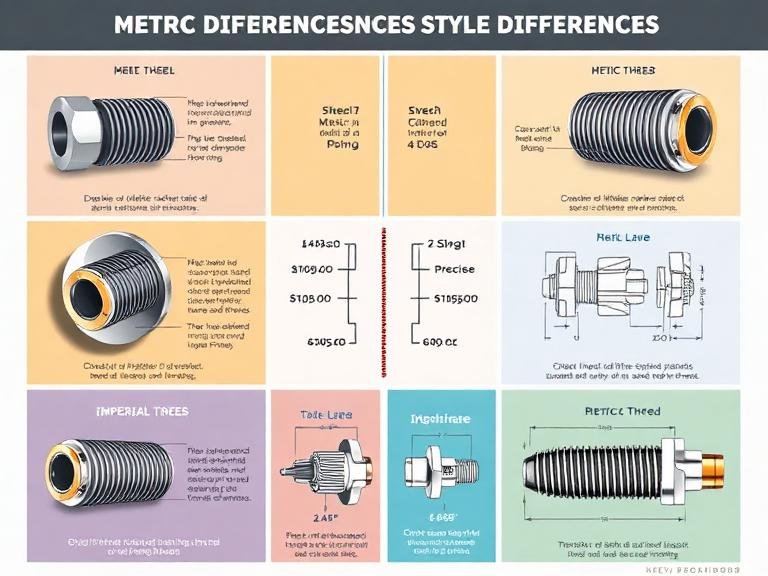
From our experience engineering precision cutting tools at Misoltap, the global supply chain is permanently fractured between the ISO Metric system and the Unified Thread Standard (UTS) dominant in North America. You cannot wish one system away. Machinists, procurement managers, and mechanical engineers must possess an aggressive, working knowledge of both standards to navigate modern manufacturing. In this comprehensive technical guide, we will brutally dissect the mechanical, geometric, and functional differences between these two systems. We will explain not only WHAT these differences are, but WHETHER you should standardize your production lines to one or the other, and how to select the right tooling to prevent expensive cross-threading disasters.
Quick Answer: The Core Distinctions
The primary Differences Between Metric and Imperial Threads lie in their unit of measurement and how their pitch is calculated. Metric threads (ISO standard) are measured in millimeters, and their pitch is defined by the exact linear distance between two thread peaks (e.g., a 1.5mm pitch). Imperial threads (Unified Thread Standard / UTS) are measured in fractions of an inch, and their pitch is defined by how many threads fit into a single inch (Threads Per Inch, or TPI). While both commonly use a 60-degree thread flank angle, their specific diameters, tolerance classes, and global availability differ significantly. Attempting to mix the two systems will immediately strip and destroy the threads.
Table of Contents
- What Are Metric and Imperial Threads?
- How It Works: The 6 Core Differences
- Benefits and Limitations of Each System
- Who Should Use Which Standard?
- Common Mistakes in Machining and Fastening
- Commercial Buying Considerations for Taps
- Expert Recommendation from Misoltap
- Frequently Asked Questions (FAQ)
What Are Metric and Imperial Threads?
Thread standards exist to ensure interchangeable parts. If you machine a threaded hole in Germany, a bolt manufactured in Japan must thread into it perfectly.
The Metric thread system is governed by the International Organization for Standardization (ISO). It is the dominant global standard. Every dimension—from the major diameter to the thread depth—is calculated in millimeters. The Imperial thread system, formally known today as the Unified Thread Standard (UTS), is the reigning standard in the United States and parts of Canada. It calculates all dimensions in inches and fractions thereof. While they serve the exact same mechanical purpose—converting rotational force into linear motion to clamp parts together—their mathematical foundations are entirely incompatible.
How It Works: The 6 Core Differences Between Metric and Imperial Threads
In most professional situations, understanding how to tap and machine these threads requires a deep dive into their geometry. Here are the six fundamental differences.
1. The Measurement Baseline (Millimeters vs. Inches)
The most obvious difference is the unit of measure. An M10 metric tap creates a thread with a nominal major diameter of 10 millimeters. An imperial tap, such as a 3/8″, creates a thread with a nominal major diameter of 0.375 inches. Because these systems do not neatly convert into whole numbers, a 10mm bolt (0.393 inches) will never fit properly into a 3/8″ hole.
2. Pitch Calculation: Distance vs. Count
This is where most beginners destroy their workpieces. Metric pitch is measured as the exact linear distance from the crest of one thread to the crest of the next, expressed in millimeters (e.g., a 1.25 pitch means the peaks are 1.25mm apart). Imperial pitch is measured as a count: the number of Threads Per Inch (TPI). A 1/4-20 bolt has 20 threads packed into exactly one inch of length. If you do not use the correct gauge to verify this before machining, your types of thread taps will jam instantly.
3. Nomenclature and Designation
Reading engineering prints requires fluency in both languages. Metric threads are denoted by a capital “M” followed by the diameter and the pitch (e.g., M8 x 1.25). If the pitch is omitted (e.g., just “M8”), it implies the standard coarse pitch. Imperial threads are denoted by the diameter, a dash, the TPI, and the thread series (e.g., 1/2-13 UNC). The UNC stands for Unified National Coarse, while UNF stands for Unified National Fine.
4. Thread Angle and Profile
Both standard ISO Metric and UTS Imperial threads share a 60-degree flank angle (the V-shape of the thread). However, legacy imperial systems, specifically the British Standard Whitworth (BSW), utilize a 55-degree angle with rounded crests and roots. If you are servicing older machinery or utilizing specific plumbing fittings, you must be aware of this angular deviation to avoid catastrophic leakages. If you are dealing with motion control, you must also understand how these profiles differ from specialized power transmission threads, requiring knowledge of acme thread vs normal thread dynamics.
5. Tolerance Classes and Fits
Both systems categorize how tightly the internal and external threads fit together. Metric threads use an alphanumeric system (e.g., 6g for external threads, 6H for internal threads) where the number dictates the tolerance grade and the letter dictates the tolerance position. Imperial threads use a simpler 1, 2, 3 system paired with ‘A’ (external) or ‘B’ (internal). For example, a 2A/2B fit is the standard commercial clearance fit, while a 3A/3B fit is a tight, precision fit used in aerospace. You must match your tap tolerances to the specific engineering print requirements.
6. Fluid Sealing Standards (NPT vs. BSPT)
When dealing with pipe threads meant to seal pressurized fluids, the differences become critical. North America relies heavily on National Pipe Taper (NPT), which is an imperial standard. The rest of the world predominantly uses British Standard Pipe (BSP), which exists in both parallel and tapered formats. They have different thread angles and pitches. If you force an NPT fitting into a BSP port, it will bind prematurely and leak under pressure. Machinists must deeply understand the tapered vs straight thread mechanics, and consult an accurate pipe thread tap size chart before cutting.
Benefits and Limitations of Each System
The primary benefit of the Metric system is its undeniable global standardization. If you are manufacturing products for international export, utilizing metric fasteners guarantees that end-users across Europe, Asia, and South America can find replacement hardware locally. Its limitation in North America is simply market inertia; many structural steel and legacy automotive supply chains are deeply entrenched in imperial measurements.
The benefit of the Imperial system is absolute dominance in the North American construction, oil and gas, and aerospace sectors. If you are machining components for a U.S. refinery, you will be cutting imperial threads. The severe limitation is mathematical complexity—dealing with fractional drill sizes (e.g., a 21/64″ drill for a 3/8-16 tap) is inherently more prone to operator calculation errors than straightforward metric decimals.
| Feature | ISO Metric Thread | Unified Imperial Thread (UTS) |
|---|---|---|
| Unit of Measure | Millimeters (mm) | Inches (in) |
| Pitch Definition | Linear distance between crests (e.g., 1.5mm) | Number of threads per inch (e.g., 16 TPI) |
| Standard Designation | M (e.g., M10 x 1.5) | UNC, UNF, UNEF (e.g., 3/8-16 UNC) |
| Thread Angle | 60 Degrees | 60 Degrees (Whitworth is 55 Degrees) |
| Tolerance System | Alphanumeric (e.g., 6H) | Numeric/Alphabetic (e.g., 2B) |
Who Should Use Which Standard?
For commercial users and international manufacturers: We recommend standardizing your entire engineering and production line to the ISO Metric system. It simplifies procurement, eliminates fractional math errors on the shop floor, and guarantees your product is globally serviceable. If you are designing consumer electronics, automotive parts, or industrial robotics, metric is the undisputed choice.
For heavy-duty applications in North America: If your company operates within the U.S. construction, aerospace, or petrochemical sectors, you must maintain extensive imperial tooling. Specifications for fluid dynamics heavily rely on imperial standards. If you are machining manifolds, you will inevitably need a 1/4 npt thread tap guide or require knowledge of the 3/8 pipe thread tap size to meet North American code requirements.
Common Mistakes in Machining and Fastening
In our testing and field observations, the most catastrophic mistake operators make is relying on visual inspection instead of a pitch gauge. Because 5/16-18 (Imperial) and M8x1.25 (Metric) are incredibly similar in diameter and pitch, operators frequently force an M8 bolt into a 5/16-18 nut. The bolt will turn a few times before violently locking up (galling). When forced with a wrench, the internal threads are completely sheared off.
Another profound error occurs during the drilling phase. Selecting the wrong tap drill size because of a metric-to-imperial conversion error results in either a broken tap or a structurally compromised thread with less than 50% thread engagement. You must use exact drill charts. Furthermore, operators often fail to adjust their drilling speed for metal based on the specific material, work-hardening the hole and instantly snapping the tap upon entry.
| Strategy | The Pros (Advantages) | The Cons (Disadvantages) |
|---|---|---|
| All-Metric Shop | Global compatibility; simplified decimal math; easier tap drill calculations. | Incompatible with legacy US equipment; limits contracts with US aerospace/defense. |
| All-Imperial Shop | Perfect alignment with US domestic supply chains and plumbing standards (NPT). | Frictional barriers to international export; complex fractional drill sizing. |
| Hybrid Shop (Both) | Maximum market flexibility; capable of servicing any global client. | Double the tooling inventory costs; high risk of operator cross-threading errors. |
Commercial Buying Considerations for Thread Taps
When procuring cutting tools from thread tap manufacturers, the system (metric or imperial) is only the first filter. You must evaluate the tap geometry. Spiral point taps push chips forward for through-holes, while spiral flute taps pull chips backward for blind holes. Do not buy a generic tap set. If you are tapping hardened steel or cast iron, you must procure specialized heavy duty tap and drill sets made from HSSE (Cobalt) or Powdered Metallurgy (PM) with TiCN coatings to survive the intense thermal friction. Additionally, if you are machining rotating assemblies (like bicycle pedals or lathe chucks), ensure your vendor can supply specialized reverse thread taps (Left-Hand taps) in your required metric or imperial sizes.
Expert Recommendation from Misoltap
In most professional situations, the cost of a broken tap or a scrapped part exponentially outweighs the price of high-quality cutting tools. Whether you are cutting precise ISO metric threads for automotive components or aggressive UNC threads for heavy machinery, utilizing cheap, unbranded taps guarantees poor thread finish, tight fits, and inevitable tool breakage.
We recommend standardizing your tool crib with geometry-specific taps designed for your exact workpiece material. At Misoltap, we engineer precision thread cutting solutions that eliminate the guesswork.
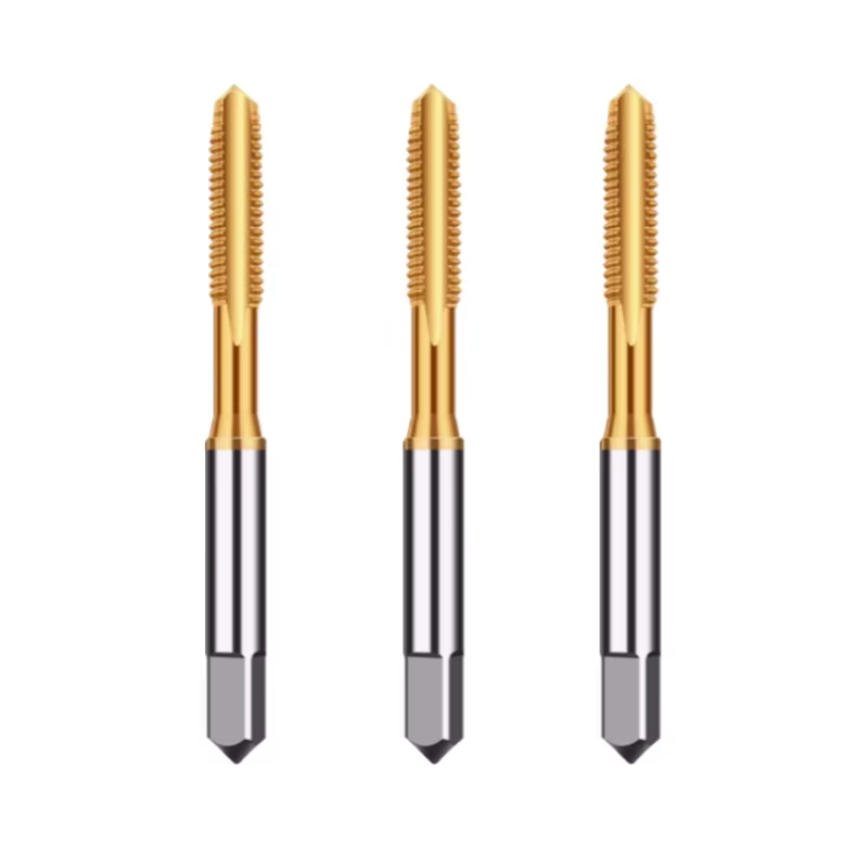
MSL002 Straight Flute Thread Tap
Engineered for exacting precision in through-hole and general-purpose tapping, the MSL002 delivers uncompromising thread quality and chip evacuation.
- Thread Size (M3*0.35): This tap is designed specifically for M3*0.35 threaded holes, providing precision and accuracy in all applications.
- Length (48mm): A compact design with a length of 48mm, suitable for various threading depths.
- Thread Length (11mm): The threading length of 11mm ensures optimal threading performance.
- Neck Length (7mm): The neck length of 7mm improves chip removal, keeping the threading process smooth.
- Handle Length (3.15mm): Features a rough handle for improved grip and control during operation.
- Square Type FE (2.55): Provides a secure fit for enhanced machine performance.
By leveraging high-performance tooling like the MSL002, you ensure that every thread you cut—whether metric or imperial—meets strict gauge tolerances and assembles flawlessly in the field.
Frequently Asked Questions (FAQ)
Can you thread a metric bolt into an imperial nut?
No. In most professional situations, forcing a metric bolt into an imperial nut (or vice versa) will cross-thread and destroy the internal threads, leading to catastrophic joint failure. Even if the diameters appear similar (like 5/16 inch and 8mm), the thread pitch and flank angles are entirely different.
Is metric thread stronger than imperial thread?
Neither is inherently stronger by design alone, as tensile strength depends primarily on the material grade (e.g., Grade 8 vs Class 10.9) and the thread series (coarse vs. fine). However, fine threads in both systems offer a larger stress area and higher tensile strength compared to coarse threads.
How do I identify if a thread is metric or imperial?
You must use a thread pitch gauge and digital calipers. Measure the outer diameter first. Then, use the pitch gauge to see if the threads align with a metric gauge (distance between peaks in millimeters) or an imperial gauge (threads per inch). Visual inspection alone is highly unreliable.
Authoritative Industry References
To ensure your mechanical assemblies and machining protocols adhere to the highest global standards, we advise consulting the following engineering authorities:
- International Organization for Standardization (ISO) – The global governing body defining the strict geometric and tolerance specifications for the ISO metric screw thread system (ISO 68-1).
- American Society of Mechanical Engineers (ASME) – The authoritative source for the Unified Inch Screw Thread standard (ASME B1.1), detailing the exact dimensions and tolerances for UNC, UNF, and UNEF threads.
- National Institute of Standards and Technology (NIST) – Provides critical foundational metrology and dimensional calibration standards ensuring precision alignment in advanced manufacturing environments.