
In the precision machining and manufacturing industry, the integrity of a threaded joint dictates the structural reliability of the entire mechanical assembly. Whether you are operating advanced multi-axis CNC machining centers or executing manual tapping operations on a conventional mill, understanding and utilizing the correct US Tap and Drill Sizes is an absolute necessity. A minor miscalculation in the pre-tap hole diameter can lead to catastrophic tool breakage, stripped threads, scrapped parts, and severe operational downtime. As the manufacturing sector demands tighter tolerances and higher throughput in 2026, the margin for error in thread cutting has effectively vanished.
Since our founding in 2005, MisolTap has established itself as a leading Chinese manufacturer of high-performance thread cutting tools. We integrate R&D, production, and global sales into a seamless operation, providing our clients with robust and precise threading solutions tailored to modern manufacturing needs. From our experience supplying aerospace, automotive, and heavy industrial sectors worldwide, we know that mastering US Tap and Drill Sizes requires more than simply glancing at a chart; it requires an understanding of thread engagement percentages, material machinability, and tool geometry. In this highly authoritative and comprehensive guide, we will dissect the mechanics of thread creation, provide an exhaustive reference for common US Tap and Drill Sizes, and detail how our premium tools can optimize your production workflows.
Table of Contents
- 1. Understanding the Unified Thread Standard (UTS)
- 2. Calculating Optimal Thread Engagement Percentages
- 3. The Comprehensive Reference Chart for US Tap and Drill Sizes
- 4. Material Considerations When Selecting US Tap and Drill Sizes
- 5. Integrating MisolTap Solutions for Precision Threading
- 6. Troubleshooting Common Threading Failures
- 7. Summary Table: Quick Selection Guide for US Tap and Drill Sizes
- 8. Frequently Asked Questions (FAQs)
- 9. References
1. Understanding the Unified Thread Standard (UTS)
Before diving into the specific US Tap and Drill Sizes, operators must comprehend the underlying framework that governs North American threaded fasteners: the Unified Thread Standard (UTS). The UTS dictates the standard thread form and series, including allowances, tolerances, and designations for screw threads commonly used in the United States and Canada. The standard is characterized by a 60-degree flank angle.
The UTS is primarily divided into two ubiquitous categories that dictate the necessary US Tap and Drill Sizes you will use on the shop floor:
- Unified National Coarse (UNC): Coarse threads possess fewer threads per inch (TPI) and feature a larger pitch. They are deeply cut, making them highly resistant to cross-threading and stripping. We recommend utilizing UNC threads when tapping into softer materials like aluminum, cast iron, or low-carbon steel, where maximum thread shear strength is required.
- Unified National Fine (UNF): Fine threads have a higher TPI and a shallower pitch. Because the minor diameter is larger compared to a UNC thread of the same major diameter, the resulting fastener is structurally stronger under tension. Furthermore, the shallow pitch angle provides superior resistance to loosening caused by intense vibration. Consequently, UNF US Tap and Drill Sizes are standard in aerospace and high-performance automotive applications.
A standard US thread designation, such as 1/4-20 UNC, identifies the nominal major diameter (1/4 inch), the threads per inch (20), and the thread series (UNC). For sizes smaller than 1/4 inch, a gauge number is used (e.g., #8-32 UNC).
2. Calculating Optimal Thread Engagement Percentages
The fundamental principle behind selecting the correct US Tap and Drill Sizes is achieving the optimal percentage of thread engagement. The tap drill creates the minor diameter of the internal thread. If the drilled hole is too small, the tap will encounter excessive rotational torque, inevitably leading to a shattered tap lodged inside the workpiece. If the drilled hole is too large, the resulting thread will lack the necessary flank engagement, leading to a stripped thread under load.
From our experience, the industry standard for general manufacturing is a 75 percent thread engagement. This specific ratio provides approximately 95 percent of the ultimate shear strength of a 100 percent thread, while reducing the required tapping torque by over 50 percent, significantly prolonging tool life.
To mathematically determine the correct drill size for a desired 75 percent thread engagement in US Tap and Drill Sizes, engineers utilize the following standardized formula:
Drill Size = Major Diameter – (0.975 / Threads Per Inch)
For example, to calculate the tap drill for a 3/8-16 UNC thread: 0.375 – (0.975 / 16) = 0.375 – 0.0609 = 0.3141 inches. The closest standard fractional drill bit to 0.3141 is 5/16 inch (0.3125 inches), making it the optimal choice.
3. The Comprehensive Reference Chart for US Tap and Drill Sizes
To ensure flawless production runs, operators require immediate access to accurate data. The following table provides an authoritative reference for the most common US Tap and Drill Sizes across both UNC and UNF series, calibrated for an optimal 75 percent thread engagement.
| Thread Size Designation | Major Diameter (Inches) | Threads Per Inch (TPI) | Recommended Tap Drill Size | Decimal Equivalent (Inches) |
|---|---|---|---|---|
| #4-40 UNC | 0.1120 | 40 | #43 | 0.0890 |
| #6-32 UNC | 0.1380 | 32 | #36 | 0.1065 |
| #8-32 UNC | 0.1640 | 32 | #29 | 0.1360 |
| #10-24 UNC | 0.1900 | 24 | #25 | 0.1495 |
| #10-32 UNF | 0.1900 | 32 | #21 | 0.1590 |
| 1/4-20 UNC | 0.2500 | 20 | #7 | 0.2010 |
| 1/4-28 UNF | 0.2500 | 28 | #3 | 0.2130 |
| 5/16-18 UNC | 0.3125 | 18 | F | 0.2570 |
| 5/16-24 UNF | 0.3125 | 24 | I | 0.2720 |
| 3/8-16 UNC | 0.3750 | 16 | 5/16 | 0.3125 |
| 3/8-24 UNF | 0.3750 | 24 | Q | 0.3320 |
| 1/2-13 UNC | 0.5000 | 13 | 27/64 | 0.4219 |
| 1/2-20 UNF | 0.5000 | 20 | 29/64 | 0.4531 |
| 5/8-11 UNC | 0.6250 | 11 | 17/32 | 0.5312 |
| 3/4-10 UNC | 0.7500 | 10 | 21/32 | 0.6562 |
| 1-8 UNC | 1.0000 | 8 | 7/8 | 0.8750 |
4. Material Considerations When Selecting US Tap and Drill Sizes
A rigid adherence to a standard chart of US Tap and Drill Sizes without evaluating the substrate material is a recipe for manufacturing inefficiency. The mechanical properties of the workpiece drastically influence how the material behaves under the immense shear forces of a cutting tap or a form tap.
When machining ductile materials such as 6061-T6 aluminum, brass, or mild steel, you can safely adhere to the standard 75 percent thread engagement recommendations found in typical US Tap and Drill Sizes charts. These materials yield predictably and clear chips effectively. However, when tapping highly abrasive or work-hardening alloys like 304 stainless steel, Inconel, or Titanium Ti-6Al-4V, torque accumulation becomes an extreme hazard.
From our experience, we recommend dropping the thread engagement to 60 or 65 percent when dealing with aerospace-grade superalloys. By selecting a slightly larger drill bit from your US Tap and Drill Sizes index, you drastically reduce the friction along the tap flanks. While this nominally reduces the theoretical pull-out strength of the thread, the reduction in tapping torque prevents catastrophic tool failure inside expensive, near-net-shape components. Always prioritize high-pressure, sulfur-based tapping fluids when working with these punishing alloys to prevent the chips from cold-welding to the tap flutes.
5. Integrating MisolTap Solutions for Precision Threading
While understanding US Tap and Drill Sizes provides the theoretical foundation, flawless execution requires world-class tooling. At MisolTap, our advanced manufacturing capabilities allow us to bridge international threading standards, ensuring that whether you are machining a block of aerospace titanium or high-volume automotive castings, you have the exact geometry required for success.
5.1 IOS-529 Thread Tap
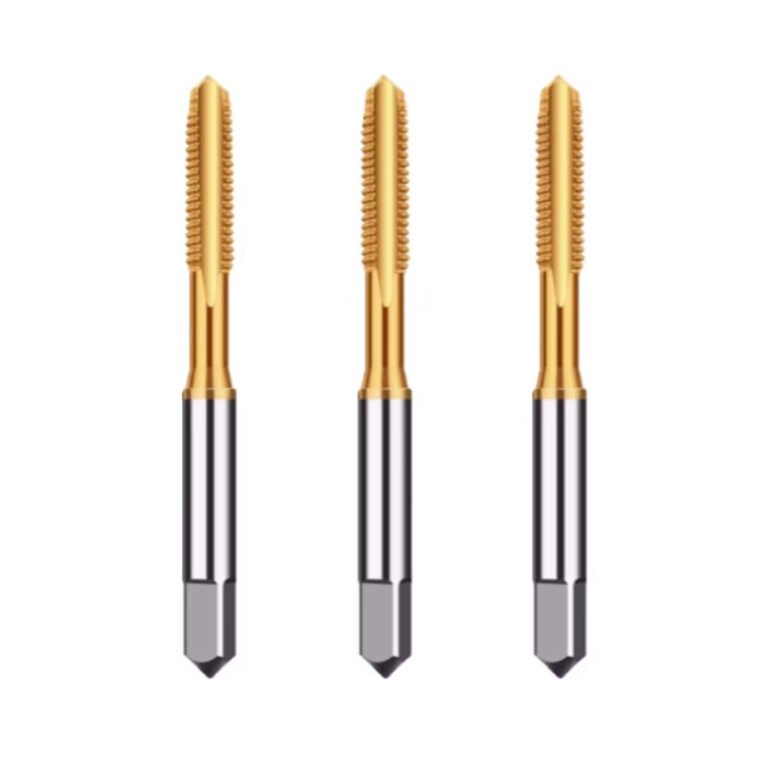
The IOS-529 standard represents a globally recognized specification for tap dimensions, focusing heavily on shank diameter and driving square proportions. Our IOS-529 Thread Tap series is engineered from premium High-Speed Steel (HSS-E) alloyed with Cobalt to withstand extreme thermal degradation. When utilizing these taps alongside standard US Tap and Drill Sizes, operators benefit from a highly rigid tool core that eliminates deflection during deep-hole tapping operations, ensuring perfectly concentric internal threads.
5.2 DIN371 Thread Tap
For manufacturers operating modern, high-speed CNC centers equipped with synchronous rigid tapping cycles, our DIN371 Thread Tap line is the ultimate solution. Featuring a reinforced shank that perfectly matches the major diameter of the thread, the DIN371 standard provides unparalleled torsional rigidity. We highly recommend these taps when executing high-volume blind hole threading. Their specialized spiral flute geometries excel at evacuating chips upward and out of the hole, preventing the deadly chip packing that destroys lesser tools.
5.3 JIS Thread Tap
The Japanese Industrial Standard (JIS) dictates unique overall length and shank specifications favored by many high-end CNC machine tool builders. Our JIS Thread Tap offerings seamlessly integrate into these specialized toolholders. When matched correctly with the corresponding US Tap and Drill Sizes, our JIS taps deliver a phenomenal surface finish on the thread flanks, reducing assembly friction and significantly improving the fatigue life of the fastened joint.
6. Troubleshooting Common Threading Failures
Even with strict adherence to the correct US Tap and Drill Sizes, operators may occasionally encounter threading defects. Diagnosing these issues rapidly is essential to maintaining production throughput.
- Oversized Threads: If a Go/No-Go gauge reveals an oversized internal thread, the primary culprit is often radial runout in the drill chuck or tap collet. If the drill bit wobbles, it creates a hole significantly larger than the intended US Tap and Drill Sizes specification, leaving too little material for the tap to engage.
- Torn or Rough Thread Flanks: This defect is almost exclusively related to poor chip evacuation or inadequate lubrication. We recommend immediately halting the cycle and verifying that the tapping fluid concentration is correct. For blind holes, switching from a straight flute tap to a spiral flute design from MisolTap will aggressively pull the chips away from the cutting zone.
- Rapid Tap Wear: If the cutting edges of the tap are rounding off prematurely, you are likely operating at a surface speed (SFM) that is too high for the substrate, or you have selected a drill size that is too small, forcing the tap to remove an excessive volume of material. Re-evaluate your US Tap and Drill Sizes selection and consider dropping to a 65 percent thread engagement.
7. Summary Table: Quick Selection Guide for US Tap and Drill Sizes
For quick reference on the shop floor, we have summarized the critical data regarding thread engagement and tool selection when dealing with US Tap and Drill Sizes.
| Machining Scenario | Target Thread Engagement | Drill Size Adjustment Strategy | MisolTap Recommendation |
|---|---|---|---|
| General Machining (Aluminum, Mild Steel) | 75% Engagement | Follow standard US Tap and Drill Sizes chart exactly. | IOS-529 Thread Tap for universal reliability. |
| Hard Alloys (Stainless Steel, Titanium) | 60% – 65% Engagement | Select a drill 1-2 sizes larger to reduce torque. | DIN371 Thread Tap for maximum torsional rigidity. |
| Deep Blind Holes | 70% Engagement | Ensure drill depth allows adequate chip clearance at the bottom. | Spiral Flute DIN371 or JIS Thread Tap for upward chip evacuation. |
| High-Vibration Environments | 75% Engagement (UNF Series) | Strictly utilize fine threads for superior tension retention. | Premium Cobalt-Alloyed Thread Taps to maintain sharp crests. |