
Navigating the complex landscape of industrial machining requires a profound understanding of mechanical fastening and power transmission. Central to this discipline is a comprehensive knowledge of the primary Thread Types and Standards utilized across global engineering sectors. Since our founding in 2005, MisolTap has established itself as a leading Chinese manufacturer of high-performance thread cutting tools. We integrate research and development, production, and global sales into a seamless operation, providing our clients with robust and precise threading solutions tailored to modern manufacturing needs.
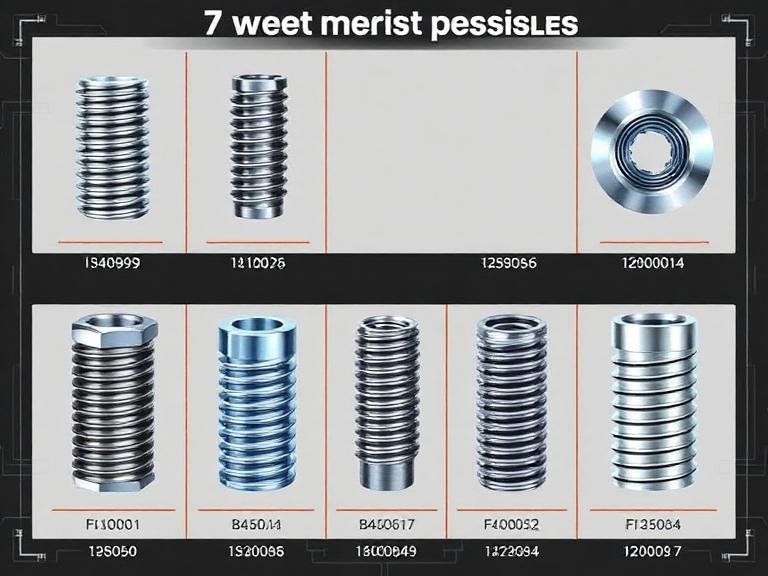
From our experience supplying aerospace, automotive, and heavy infrastructure industries, misidentifying or misapplying Thread Types and Standards is a leading cause of mechanical failure, fluid leakage, and costly production downtime. Engineers and machinists must command a strict understanding of thread geometry, pitch, flank angles, and tolerance classes to ensure structural integrity. We recommend mastering the 6 key Thread Types and Standards outlined in this guide to optimize your manufacturing workflows, reduce tool wear, and guarantee assembly precision.
Table of Contents
- Summary Table: The 6 Key Thread Types and Standards
- The Engineering Importance of Thread Types and Standards
- 1. Unified National Thread Series (UNC, UNF, UNEF)
- 2. ISO Metric Thread Standard (M)
- 3. National Pipe Taper Thread (NPT)
- 4. British Standard Pipe (BSPT / BSPP)
- 5. Acme Thread Series
- 6. Buttress Threads
- Expert Tooling Selection for Various Thread Types and Standards
- Frequently Asked Questions (FAQs)
- Industry References
Summary Table: The 6 Key Thread Types and Standards
To provide a quick reference matrix for production planning, we have summarized the foundational parameters of the most prevalent Thread Types and Standards used in contemporary machining.
| Thread Standard | Flank Angle | Primary Application | Geometry Profile |
|---|---|---|---|
| Unified National (UN) | 60 Degrees | General fastening in North America | Straight / Cylindrical |
| ISO Metric (M) | 60 Degrees | Global standard for general fastening | Straight / Cylindrical |
| National Pipe Taper (NPT) | 60 Degrees | Pressure-tight fluid and gas sealing | Tapered (3/4 inch per foot) |
| British Standard Pipe (BSP) | 55 Degrees | Hydraulic and pneumatic plumbing internationally | Tapered (BSPT) or Parallel (BSPP) |
| Acme Thread | 29 Degrees | Heavy load power transmission and linear motion | Trapezoidal |
| Buttress Thread | 45 / 7 Degrees | High unidirectional axial thrust (e.g., hydraulic jacks) | Asymmetrical |
The Engineering Importance of Thread Types and Standards
Before dissecting individual profiles, it is critical to address why rigid adherence to Thread Types and Standards dictates manufacturing success. A thread is an inclined plane wrapped around a cylinder or cone. The specific geometry of this plane controls how mechanical force translates into clamping pressure, fluid sealing, or linear motion. From our experience at MisolTap, deviation from these standards leads to thread galling, cross-threading, and catastrophic assembly failure.
Understanding these Thread Types and Standards allows machinists to select the correct pre-drill hole sizes, feed rates, and cutting tools. Applying a metric tap to a Unified National pre-drill hole will result in immediate tool breakage or stripped threads. Therefore, mastery of Thread Types and Standards is the bedrock of professional CNC and manual machining.
1. Unified National Thread Series (UNC, UNF, UNEF)
The Unified National thread form is the primary standard utilized in the United States and Canada for general-purpose fastening. Established to unify British, Canadian, and American manufacturing post-World War II, this standard features a 60-degree flank angle with flat crests and rounded roots. The series is further divided by pitch:
- UNC (Unified National Coarse): Features fewer threads per inch. We recommend UNC threads for materials with lower tensile strength, such as aluminum and cast iron, as the deeper thread engagement prevents stripping.
- UNF (Unified National Fine): Features more threads per inch, offering greater tensile strength and superior resistance to vibrational loosening. Ideal for aerospace and automotive applications.
- UNEF (Unified National Extra Fine): Utilized for thin-walled components and high-precision instrument adjustments.
2. ISO Metric Thread Standard (M)
The ISO Metric thread is the globally recognized baseline for fastening, dominating European and Asian manufacturing. Like the Unified National series, the ISO Metric standard employs a symmetrical V-shaped thread with a 60-degree flank angle. However, the nomenclature is strictly millimeter-based. A designation such as M10 x 1.5 indicates a nominal major diameter of 10 millimeters and a pitch (the distance between adjacent crests) of 1.5 millimeters.
From our experience, the widespread adoption of the ISO Metric standard simplifies global supply chains. When tooling for these Thread Types and Standards, machinists must calculate the core drill size precisely by subtracting the pitch from the major diameter.
3. National Pipe Taper Thread (NPT)
When engineering fluid and gas transport systems, straight threads are inadequate for pressure containment. The National Pipe Taper (NPT) standard resolves this by incorporating a taper rate of 3/4 inch per foot. As the male and female threads are torqued together, the taper forces the flanks, crests, and roots to compress, forming a mechanical seal. We highly advise reading our 1/4 npt thread tap guide to master the unique machining dynamics of taper generation.
Sizing for pipe threads can be notoriously confusing, as the nominal size refers to the inner diameter of the pipe rather than the thread’s major diameter. To prevent machining errors, consult a reliable pipe thread tap size chart. For larger fluid applications, understanding the specifics of the 3/8 pipe thread tap size is essential. Furthermore, deciding between sealing profiles requires a deep dive into tapered vs straight thread mechanics.
4. British Standard Pipe (BSPT / BSPP)
Outside of North America, the British Standard Pipe (BSP) dominates fluid power and plumbing arrays. Unlike the 60-degree NPT profile, BSP threads utilize a 55-degree Whitworth profile with rounded crests and roots. This standard is divided into two categories:
- BSPT (British Standard Pipe Taper): Similar in function to NPT, relying on a taper to achieve a pressure-tight seal.
- BSPP (British Standard Pipe Parallel): Employs a straight thread and requires a bonded seal ring or O-ring to prevent fluid leakage.
Attempting to mate NPT and BSP threads is a critical error, as the differing flank angles and pitches will compromise the connection under pressure.
5. Acme Thread Series
Unlike V-shaped fastening threads, Acme threads are designed explicitly for power transmission and linear motion control. Originating in the late 19th century to replace square threads, the Acme profile features a 29-degree flank angle, creating a trapezoidal shape. This robust geometry allows for high load-bearing capacity in machine tool lead screws, C-clamps, and industrial valves.
We recommend evaluating the operational load when choosing between power threads. For a comprehensive structural comparison, review our analysis on acme thread vs normal thread profiles to determine the most efficient method for torque-to-thrust conversion.
6. Buttress Threads
The Buttress thread is a highly specialized, asymmetrical profile engineered to withstand extreme axial thrust in one singular direction. It features a nearly vertical load-bearing face (typically 7 degrees) and a highly slanted trailing face (typically 45 degrees). This unique configuration combines the low friction of a square thread with the shear strength of a V-thread.
Buttress threads are essential in heavy machinery, hydraulic presses, and artillery breech blocks. Due to their asymmetry, they cannot accommodate bidirectional heavy loads, limiting their scope but excelling in their dedicated application.
Expert Tooling Selection for Various Thread Types and Standards
Identifying the correct Thread Types and Standards is only the first phase of the engineering process; executing the cut requires premium tooling. At MisolTap, we engineer high-speed steel (HSS) and carbide taps explicitly calibrated for these diverse thread forms. When building your tool crib, you must evaluate the types of thread taps available, such as spiral point taps for through holes and spiral flute taps for blind holes.
For large-scale, high-torque applications in hardened steel, employing a heavy duty tap and drill combination is non-negotiable to prevent catastrophic tool failure within the workpiece. The machining environment also demands precise parameter control; calculating the correct drilling speed for metal dictates the quality of the internal bore prior to tapping.
Occasionally, mechanical assemblies require left-handed rotation to prevent operational loosening (such as on rotating shafts or turnbuckles). In these instances, reverse thread taps must be utilized. Sourcing these specialized tools requires partnering with elite thread tap manufacturers capable of maintaining microscopic tolerances across complex geometries.
Frequently Asked Questions (FAQs)
Industry References
To further expand your comprehension of global Thread Types and Standards and their strict geometric tolerances, we encourage consulting the definitive manuals provided by the following international standards organizations: