
Machining internal threads is one of the most critical and unforgiving operations in modern manufacturing. Unlike drilling or milling, tapping usually occurs at the final stages of part production. If a tap breaks inside the workpiece, you risk scrapping a highly valuable component. The single most common reason machinists destroy tools and scrap parts is a failure to understand the dynamic differences between blind holes vs. through holes, and subsequently selecting the wrong cutting tool for the job.
From our experience at MisolTap, manufacturing high-performance thread cutting tools since 2005, there is no universal tap. A tool designed to excel in an open-ended flange will fail catastrophically in a solid engine block. This guide delivers commercial and practical judgment on how to approach both configurations, what tools to specify, and how to eliminate tap breakage on your shop floor.
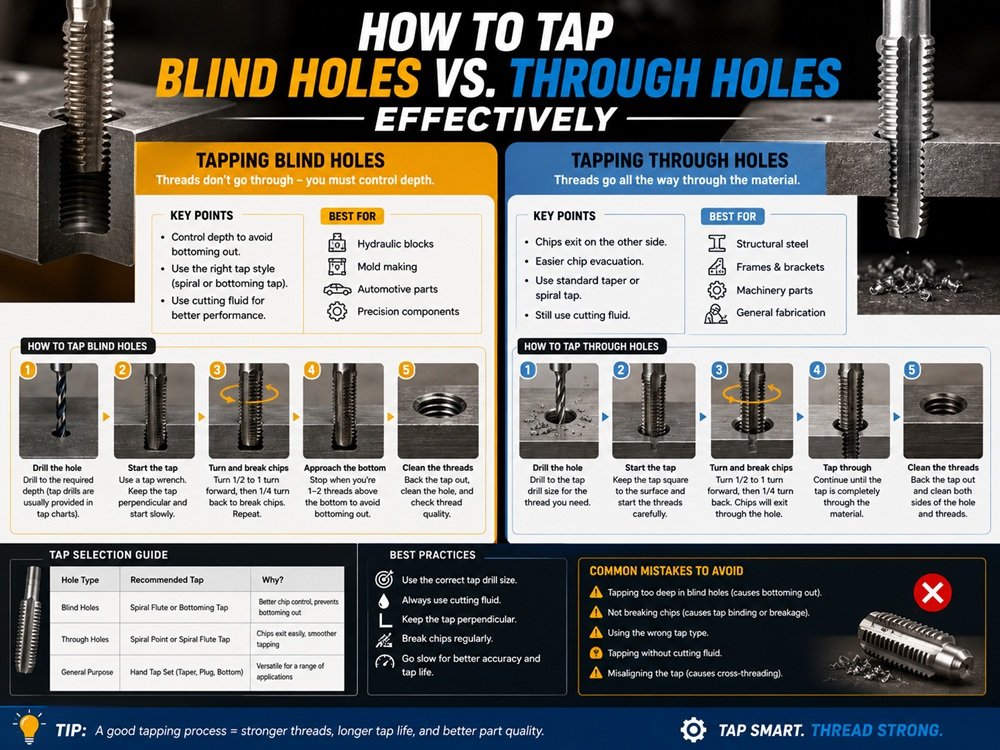
Quick Answer: Tapping Blind vs. Through Holes
The primary difference when tapping lies in chip evacuation.
- Through Holes: The hole goes entirely through the material. You must use a Spiral Point Tap (Gun Tap), which pushes the metal chips forward and out the bottom of the hole.
- Blind Holes: The hole stops inside the material, trapping chips. You must use a Spiral Flute Tap (to pull chips up and out like a drill bit) or a Forming Tap (which displaces metal without creating chips). Never use a spiral point tap in a blind hole.
For beginners and seasoned machinists alike, selecting the correct tap geometry based on the hole type is the absolute law of threading.
Table of Contents
- Direct Answer: The Mechanics of the Cut
- What They Are and How They Work
- Benefits and Limitations
- Who Should Use Which Configuration
- Common Machining Mistakes
- Buying Considerations: Choosing the Right Tool
- Expert Recommendation from MisolTap
- Frequently Asked Questions
- Authoritative References
Direct Answer: The Mechanics of the Cut
When you evaluate blind holes vs. through holes, your entire machining strategy must revolve around where the waste material (chips) will go. In our testing, attempting to force chips into a confined space requires exponentially more machine torque, rapidly generating heat and causing the high-speed steel (HSS) to fatigue and fracture.
To tap effectively, you must master the relationship between the hole type and the tap’s chamfer and flute geometry. If you are learning how to tap threads in metal, your first step is verifying your hole depth. A through hole allows you to use a longer chamfer (taper tap or plug tap), which spreads the cutting load over multiple teeth, extending tool life. A blind hole forces you to use a bottoming tap (1 to 2 threads of chamfer) to cut threads as close to the bottom of the cavity as possible, placing immense stress on the first few cutting teeth.
What They Are and How They Work
Through Holes
A through hole is exactly what it sounds like: a drilled cavity that penetrates completely through the workpiece. How it works from a threading perspective is highly forgiving. Because the bottom is open, chips pushed forward by the cutting action simply fall out onto the machine table. Furthermore, cutting fluids can easily flow through the hole, providing superior lubrication and cooling.
Blind Holes
A blind hole is drilled to a specific depth without breaking through the opposite side of the workpiece. Tapping these requires precision. Because there is no exit, cutting chips will accumulate at the bottom of the hole. If you continue to drive a tap downward into this packed mass of chips, the tap will bind and shatter. To make a blind hole work, you must either pull the chips upward using a spiral flute, or eliminate chips entirely by using a thread forming process. Additionally, consulting a strict tap and drill size chart is critical to ensure you have drilled enough clearance depth past your required thread depth.
| Feature | Through Hole | Blind Hole |
|---|---|---|
| Exit Point | Open at the bottom | Closed at the bottom |
| Chip Direction | Pushed forward (down) | Pulled backward (up) |
| Preferred Tap Type | Spiral Point (Gun Tap) | Spiral Flute or Roll/Forming Tap |
| Machining Difficulty | Low to Medium | High |
Benefits and Limitations
Engineers do not specify blind holes to make a machinist’s life difficult; they serve specific mechanical purposes. Understanding the pros and cons of each configuration dictates how a component is manufactured.
| Hole Type | Benefits | Limitations |
|---|---|---|
| Through Hole | Easy chip evacuation; longer tool life; easier to inspect thread quality; can use faster machining speeds. | Leaves an open path for fluids/gases to escape; alters the cosmetic appearance of both sides of the part. |
| Blind Hole | Preserves a pristine exterior face; creates a hermetic seal against fluids/gases; increases overall structural rigidity. | Requires precise depth control; high risk of tap breakage; chips must be actively managed; harder to clean and inspect. |
Who Should Use Which Configuration
For commercial users: Through holes should be utilized whenever structural brackets, base plates, or mounting flanges are being designed. If the opposite side of the material is hidden or aesthetically irrelevant, always design a through hole. It will drastically lower your tooling costs and cycle times.
For heavy-duty applications: Blind holes are mandatory in hydraulic manifolds, engine blocks, and pneumatic cylinders. In these systems, piercing the outer wall would cause catastrophic pressure loss. When sealing fluids, engineers often specify a tapered vs straight thread inside a blind hole to create a mechanical fluid seal.
Who does not need blind holes? For beginners fabricating basic jigs, fixtures, or hobbyist projects, avoid blind holes entirely. Design your parts so you can drill completely through, saving you frustration and broken tooling.
Common Machining Mistakes
In most professional situations, we observe operators making the same critical errors when dealing with blind holes vs. through holes:
- Mistake 1: Using Spiral Point Taps in Blind Holes. This is the most common cause of tool breakage. Spiral point taps shoot chips forward. In a blind hole, those chips compress at the bottom until they become a solid puck of metal, instantly snapping the tap.
- Mistake 2: Inadequate Drill Depth. When tapping a blind hole, you need space for the unthreaded chamfer of the tap and a pocket for chips. If you need 1 inch of usable threads, drilling the hole exactly 1 inch deep will result in the tap crashing into the bottom. Always drill 10% to 15% deeper than your required thread depth.
- Mistake 3: Ignoring Feed Rates and RPM. Knowing the correct drilling speed for metal is just as important as your tapping speed. Hardened steels require strict RPM limits and heavy cutting oils to prevent the tap from welding to the workpiece.
- Mistake 4: Using Hand Taps on CNC Machines. There is a massive machine tap vs hand tap performance gap. Hand taps have straight flutes that neither push nor pull chips effectively. They require the operator to constantly reverse the tap to break chips. For automated CNC work, always use geometry-specific machine taps.
Buying Considerations: Choosing the Right Tool
Whether it is actually worth buying premium taps depends on your production volume. For high-volume manufacturing, the cost of a broken tap inside a machined aerospace part far exceeds the price of premium tooling. You must categorize your tooling purchases by the specific types of thread taps suited for your hole.
| Hole Configuration | Material Type | Recommended Tap Geometry | Why We Recommend It |
|---|---|---|---|
| Through Hole | Steel / Cast Iron | Spiral Point Tap | Pushes chips ahead of the cut; highly rigid design allows for faster spindle speeds. |
| Through Hole | Aluminum / Brass | Forming Tap (Roll Tap) | Produces no chips; creates a stronger thread via cold forming. |
| Blind Hole | Steel / Stainless | Spiral Flute Tap (Slow to Fast Spiral) | Acts like an auger, actively lifting chips out of the top of the hole to prevent bottom packing. |
| Blind Hole | Aluminum / Copper | Forming Tap (Roll Tap) | Eliminates chip extraction issues entirely; excellent for deep blind holes. |
| Pipe Threads (Blind/Through) | Castings / Manifolds | Interrupted Thread Pipe Tap | Consult a pipe thread tap size chart. Interrupted threads reduce friction and heat buildup. |
When selecting standard tooling, ensure you understand international shank and square drive specifications. If your collets are formatted for European standards, you will need a din371 thread tap supplier to ensure rigid concentricity. Alternatively, for international standardization, check your ios 529 thread tap supplier options to match your CNC tool holders perfectly.
Expert Recommendation from MisolTap

Since our founding in 2005, MisolTap has established itself as a leading Chinese manufacturer of high-performance thread cutting tools. We integrate R&D, production, and global sales into a seamless operation, providing our clients with robust and precise threading solutions tailored to modern manufacturing needs.
We recommend a complete shift toward Thread Forming Taps (Roll Taps) whenever you are tapping blind holes in ductile materials (like aluminum, low-carbon steel, or brass). Because forming taps displace metal rather than cutting it, they generate zero chips. This completely eradicates the issue of chip packing at the bottom of a blind hole. Furthermore, the cold-working process results in threads that are structurally stronger. If your engineering prints allow for it, and your material is soft enough, abandoning cutting taps for forming taps in blind hole applications will drastically lower your scrap rates and maximize tool life.
For standard thread sizing parameters, always rely on high-precision data, such as our 1/2 thread tap size chart, to verify your core hole diameter before attempting a form tap, as form tapping requires a slightly larger pre-drilled hole than conventional cutting.
Frequently Asked Questions (FAQ)
Can you use a through hole tap in a blind hole?
In most professional situations, we strongly advise against this. Through hole taps (like spiral point taps) push chips forward. If used in a blind hole, the chips will pack at the bottom, causing the tap to bind and snap off inside the workpiece.
How deep should I drill a blind hole before tapping?
You must drill the hole deeper than the required thread depth. We recommend drilling at least 3 to 5 threads deeper than your required full thread depth to accommodate the tap’s unthreaded chamfer and provide clearance space for chip accumulation.
What is the best tap for a blind hole in aluminum?
For softer, ductile materials like aluminum, we recommend using a thread forming tap (roll tap) because it generates no chips. If cutting threads is explicitly required by the drawing, use a fast spiral flute tap to aggressively pull chips up and out of the hole.
Authoritative References
To ensure your machining operations meet global engineering standards, we recommend reviewing the threading specifications maintained by the following authoritative institutions:
- American Society of Mechanical Engineers (ASME) – Publishers of the ASME B1.1 standard for Unified Inch Screw Threads, detailing exact tolerance classes for both blind and through hole thread engagement.
- International Organization for Standardization (ISO) – Governing body for metric threading standards (ISO 68-1) and tool holder specifications (such as DIN and ISO standards for machine taps).
- Massachusetts Institute of Technology (MIT) – Department of Mechanical Engineering – Academic resources and machine shop guidelines emphasizing safe tooling practices, chip load calculations, and advanced tap geometry selection.