
Since our founding in 2005, MisolTap has established itself as a leading Chinese manufacturer of high-performance thread cutting tools. We integrate R&D, production, and global sales into a seamless operation, providing our clients with robust and precise threading solutions tailored to modern manufacturing needs. When it comes to industrial threading, we do not guess; we engineer.
In the machining and manufacturing industry, selecting the wrong threading standard is not a minor inconvenience—it is a catastrophic error that ruins expensive workpieces, breaks tooling, and halts assembly lines. The debate between Metric vs. Imperial thread taps is one of the most fundamental decisions a production manager must make. If you are producing parts for a modern global supply chain, or if you are maintaining legacy American machinery, understanding the explicit mechanical differences between these two systems is absolutely non-negotiable.
From our experience supplying aerospace, automotive, and heavy-machinery sectors worldwide, we constantly see procurement teams order incorrect tap specifications because they fail to understand the dimensional realities of thread pitches and root diameters. It is not just about converting millimeters to inches; it is about thread class tolerances, flank angles, and matching the exact application requirement. In this definitive guide, we will break down the engineering realities of Metric vs. Imperial thread taps, equipping you with the commercial and practical judgment needed to make the right tooling decisions for your shop floor.
Quick Answer
Metric vs. Imperial thread taps represent two entirely different measurement standards for cutting internal threads. Metric taps are defined by their major diameter in millimeters and the linear distance between thread crests (pitch) in millimeters (e.g., M8 x 1.25). Imperial taps, governed by the Unified Thread Standard (UTS), are defined by their major diameter in fractional inches or gauge numbers, and the number of Threads Per Inch (TPI) (e.g., 5/16-18 UNC).
In most professional situations, we recommend Metric taps for all new, globally exported product designs due to their universal standardization and ease of calculation. Imperial taps remain strictly necessary for the North American market, aerospace sectors, and legacy equipment maintenance. You cannot interchange them; forcing a metric fastener into an imperial threaded hole will result in stripped threads and joint failure.
Table of Contents
- What Are Metric and Imperial Thread Taps?
- How Thread Geometry Works
- Benefits of Each Standard
- Limitations and Mechanical Drawbacks
- Who Should Use Metric vs. Imperial
- Who Does Not Need Certain Taps
- Common Machining Mistakes
- Buying Considerations
- MisolTap Expert Recommendation
- Frequently Asked Questions (FAQ)
What Are Metric and Imperial Thread Taps?
A thread tap is a precision cutting tool used to create internal threads inside a pre-drilled hole, allowing a bolt or screw to fasten securely. The distinction between Metric and Imperial lies in the mathematical framework that dictates the tap’s physical dimensions.
Metric Thread Taps: Governed primarily by ISO (International Organization for Standardization) specifications, metric threads are the global default. When you see a designation like “M10 x 1.5”, the “M” denotes a standard metric thread profile. The “10” is the nominal major diameter of the thread in millimeters. The “1.5” is the pitch—the exact linear distance in millimeters from one thread peak to the next. The mathematics are highly intuitive and decimal-based.
Imperial Thread Taps: Governed by the UTS (Unified Thread Standard) developed by the United States, Canada, and the United Kingdom, imperial taps use inch-based fractions and whole numbers. A designation like “3/8-16 UNC” indicates a 3/8-inch major diameter and 16 Threads Per Inch (TPI). UNC stands for Unified National Coarse, while UNF stands for Unified National Fine. For diameters under 1/4 inch, imperial taps use a numbered gauge system (e.g., #8-32), which requires machinists to memorize or constantly reference a tap and drill size chart.
How Thread Geometry Works
Both standard ISO Metric and Unified Imperial threads share a critical similarity: they both utilize a 60-degree V-shaped thread profile (flank angle). However, the way a tap cuts into the metal substrate relies entirely on the pre-drilled hole size, known as the minor diameter. Understanding how to tap threads in metal requires perfect alignment between the tap specification and the drill bit.
For a Metric tap, calculating the tap drill size is straightforward: Major Diameter – Pitch = Tap Drill Size. For example, an M8 x 1.25 tap requires a 6.75mm drill (8 – 1.25 = 6.75). It is elegant and mathematically pure.
For an Imperial tap, the calculation is more cumbersome: Major Diameter – (1 / TPI) = Tap Drill Size. For a 3/8-16 tap, the calculation is 0.375 – (1/16) = 0.3125 inches, which corresponds to a 5/16-inch drill bit. In a busy CNC shop, these fractional conversions increase the risk of operator error if quick-reference charts are not strictly utilized.
Furthermore, it is vital to note that not all threads are straight fastening threads. Fluid dynamics often require tapered profiles to create a hermetic seal. When dealing with pipe threads, you must understand the distinction between tapered vs straight thread applications. For instance, NPT (National Pipe Taper) is an imperial standard crucial for fluid sealing in North America. We highly advise consulting a 1/4 npt thread tap guide before attempting any plumbing or pneumatic machining.
Benefits of Each Standard
Choosing the right thread standard impacts your supply chain, product serviceability, and overall manufacturing efficiency.
| Standard | Primary Benefits | Industrial Application Advantages |
|---|---|---|
| ISO Metric | Universal global standardization (except USA). Simple, decimal-based tap drill calculations. Easier inventory management due to standardized pitch variants. | Ideal for high-volume manufacturing, automotive parts, consumer electronics, and products intended for global export. Eliminates confusion during international assembly. |
| UTS Imperial | Deep integration in North American infrastructure. Exceptionally strong coarse (UNC) thread pull-out resistance in soft metals like aluminum. Extensive legacy data and tooling availability in the US. | Mandatory for aerospace components (often operating on UNJ specifications), heavy construction in the US, and servicing legacy agricultural or industrial equipment. |
Limitations and Mechanical Drawbacks
In our testing, we observe distinct mechanical limitations depending on how these taps are deployed.
Metric Limitations: For manufacturers located strictly in the United States, relying entirely on metric fasteners can frustrate end-users who may only possess imperial wrenches and hex keys. Furthermore, standard coarse metric threads can sometimes offer slightly less vibration resistance than fine imperial threads (UNF) in highly dynamic mechanical environments.
Imperial Limitations: The sheer complexity of the numbering system is a massive bottleneck. Memorizing that a #10-32 tap requires a #21 drill bit is archaic and prone to error. Additionally, outside of North America and the UK, sourcing imperial replacement fasteners is expensive and time-consuming, severely limiting the international serviceability of a product.
Who Should Use Metric vs. Imperial
For commercial users launching new products: We strongly advise defaulting to Metric. Whether you are machining consumer electronics enclosures or designing modern robotics, the global supply chain operates on millimeters. Sourcing metric fasteners and tooling in bulk is significantly more cost-effective on a global scale.
For heavy-duty applications in the Americas: If you are manufacturing structural steel beams, oil rig components, or maintaining commercial aircraft in the United States, you must use Imperial. The established engineering blueprints, safety certifications, and existing infrastructure demand compliance with UTS and ASME standards.
Who Does Not Need Certain Taps
If you operate a CNC machine shop in Europe or Asia focusing on local domestic contracts, you absolutely do not need to stock a massive library of Imperial taps. Conversely, if you are a specialized restoration shop rebuilding 1960s American muscle cars, investing heavily in Metric tooling is a waste of capital. Your tooling inventory must reflect your client base. To understand the exact tooling you need to stock, review the types of thread taps available before making bulk purchases.
Common Machining Mistakes
The most devastating mistake we see is the “close enough” approach. An M8 x 1.25 thread has an outer diameter of roughly 7.9mm and a pitch of 1.25mm (equivalent to 20.3 TPI). A 5/16-18 UNC thread has an outer diameter of 7.93mm and 18 TPI. Because the outer diameters are nearly identical, inexperienced operators will attempt to force a 5/16 bolt into an M8 threaded hole. It will turn for about one and a half rotations before binding. If forced with a wrench, it will instantly cross-thread, destroying the internal threads and ruining the workpiece.
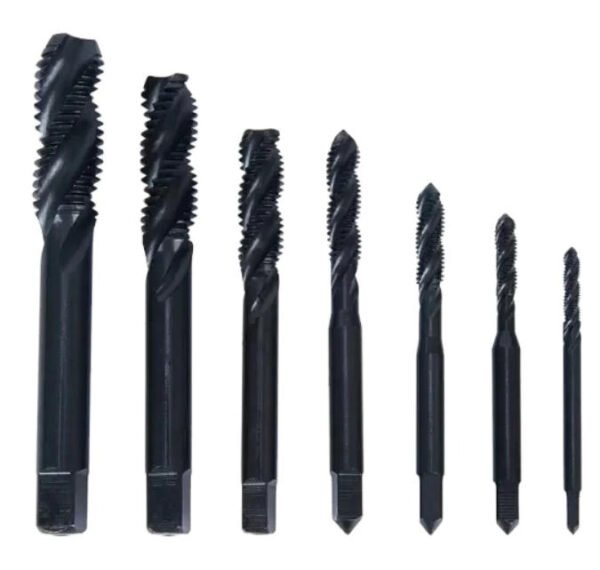
Another major error is failing to differentiate between tooling designed for manual use versus automated machining. Using a standard straight-flute hand tap in a high-speed CNC mill will result in poor chip evacuation and instant tap breakage. You must understand the machine tap vs hand tap differences. CNC applications require spiral point (for through holes) or spiral flute (for blind holes) machine taps.
Buying Considerations
When purchasing taps from MisolTap or any high-end manufacturer, you must evaluate specific technical criteria beyond just the thread standard.
| Consideration | What to Look For | Why it Matters |
|---|---|---|
| Material Grade | HSS-E (High-Speed Steel with Cobalt) or Solid Carbide. | Standard HSS dulls quickly when machining tough alloys like 304 Stainless or Inconel. Cobalt-alloyed HSS offers superior heat and wear resistance. |
| Tool Coating | TiN (Titanium Nitride), TiCN, or TiAlN. | Coatings reduce friction and prevent built-up edge (BUE) when tapping soft, gummy materials like aluminum. |
| Flute Geometry | Spiral Point (Through Holes) vs. Spiral Flute (Blind Holes). | Spiral point pushes chips forward ahead of the tap. Spiral flute pulls chips upward and out of a blind hole, preventing the tap from packing with chips and snapping. |
| Thread Class Tolerance | Metric 6H / Imperial 2B (Standard Fit). | Determines how tight the fastener will fit. Aerospace requires tighter tolerances (e.g., 3B), while standard manufacturing uses 2B/6H to allow for plating allowances. |
Furthermore, when dealing with fluid and gas transfer, do not guess pipe sizes. An Imperial 1/2-inch pipe tap does not measure 0.5 inches in diameter. You must consult a pipe thread tap size chart or a specific 1/2 thread tap size chart to verify the correct pre-drill parameters for NPT or BSPT applications.
Expert Recommendation
The MisolTap Verdict
From our extensive experience engineering cutting tools for the global market, we firmly advise manufacturing facilities to standardize on ISO Metric threads for all proprietary product designs. The simplicity of the metric system reduces engineering time, minimizes operator error on the shop floor, and guarantees your product is serviceable in 95% of the global market.
However, practical commercial judgment dictates that if you are a job shop accepting external contract work, you cannot afford to ignore the Imperial standard. We recommend outfitting your tool crib with premium HSS-E cobalt Metric machine taps for primary production, while maintaining a dedicated, high-quality inventory of UNC and UNF taps to service North American clients and legacy repairs.
Finally, regardless of the standard you choose, never compromise on thread geometry. If your application involves heavy vibration, consider reading about acme thread vs normal thread profiles for linear motion, and always ensure you are using the correct left hand thread tap set when addressing counter-rotational mechanical assemblies.
Frequently Asked Questions (FAQ)
Can I use a metric tap in an imperial hole, or vice versa?
Absolutely not. While some sizes appear similar in major diameter (like M8 and 5/16), the pitch (distance between threads) is entirely different. Forcing a tap of the wrong standard into an existing hole will cross-thread and destroy the internal geometry, resulting in zero holding power.
Why does the USA still use Imperial thread taps?
The persistence of the Unified Thread Standard (Imperial) in the USA is largely due to the massive existing infrastructure in construction, aerospace, and legacy manufacturing. Converting millions of engineering drawings, tooling inventories, and established safety certifications to metric presents an astronomically high capital cost for American industries.
What is the difference between UNC and UNF in Imperial taps?
UNC stands for Unified National Coarse, which has fewer threads per inch. It is ideal for rapid assembly and tapping into softer materials like aluminum or cast iron where deep thread engagement is needed to prevent stripping. UNF stands for Unified National Fine, which has more threads per inch, providing higher tensile strength and better resistance to loosening under vibration in hard steel applications.
References & Industry Standards
- International Organization for Standardization (ISO) – Governing body for the ISO metric screw thread standard (ISO 68-1).
- American Society of Mechanical Engineers (ASME) – Publishers of the B1.1 Unified Inch Screw Threads standard utilized across North American manufacturing.
- National Institute of Standards and Technology (NIST) – Federal agency detailing the historical context and precision measurement guidelines for US customary units and metrication.